
AI Lab Vendors in India for Schools:
A Practical Guide to Choosing the Right Partner
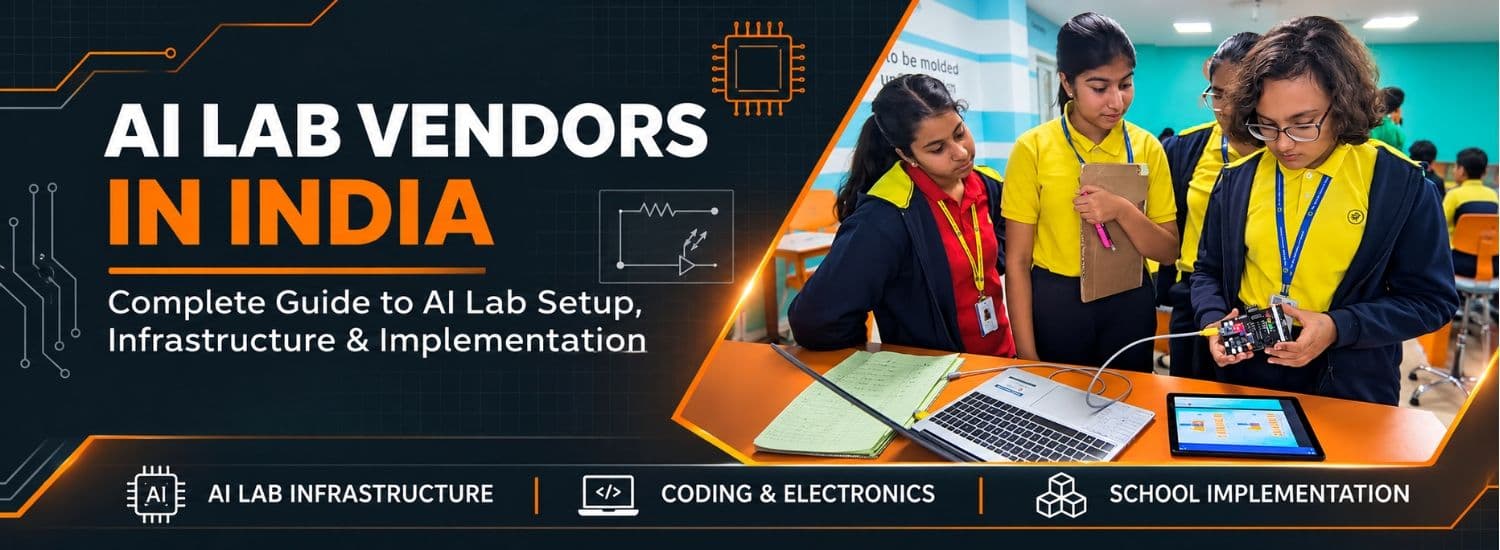


AI Lab Vendors in India for Schools: Complete Guide to AI Lab Setup, Infrastructure and Implementation
Introduction: Why Schools Need AI Labs
Introduction
Artificial Intelligence is changing the way the world works, communicates and solves problems. From smart assistants and autonomous vehicles to healthcare technology and industrial automation, AI is becoming an essential part of everyday life. As these technologies continue to evolve, schools must prepare students with the knowledge and practical skills required to participate in a technology-driven future.
This growing demand has increased the importance of AI Lab Vendors in India for schools, as educational institutions look for reliable partners who can introduce Artificial Intelligence, Robotics, IoT and Automation into their learning environments.
An AI laboratory is more than a room equipped with computers and electronic devices. It is a dedicated learning environment where students understand emerging technologies through experimentation, project development and practical application.
Today, schools are exploring AI Lab Setup Companies in India that can provide complete educational solutions, including infrastructure, equipment, curriculum, teacher training and academic support.
However, selecting the right vendor requires careful consideration. Schools need a partner that understands educational requirements, develops age-appropriate learning resources and ensures that students receive meaningful hands-on experience.
In this article, we explore the essential components of an AI laboratory, the factors schools should consider before selecting top ai lab vendors, and how an integrated approach can create future-ready learning opportunities.
1. Why Are AI Labs Becoming Important in Schools?
Artificial Intelligence is no longer limited to engineering colleges, research institutions or technology companies. Students can now explore AI concepts through age-appropriate activities, interactive software, robotics projects and practical experiments.
An Artificial Intelligence Lab for Schools introduces students to how intelligent systems work and how technology can be used to solve real-world problems.
Instead of simply reading about Artificial Intelligence, students can experiment with image recognition, voice recognition, data analysis, machine learning and automation.
Schools looking for AI Lab Providers in India should understand that a successful laboratory must combine theoretical knowledge with practical learning opportunities.
Similarly, AI Lab Setup for Schools should focus on developing the following skills:
- Computational thinking and logical reasoning.
- Programming and coding fundamentals.
- Understanding Artificial Intelligence.
- Robotics and automation.
- Problem-solving and critical thinking.
- Creativity and innovation.
- Collaboration and teamwork.
- Project development and presentation.
These skills help students understand technology while developing the confidence to experiment, create and innovate.
For this reason, AI Lab Vendors in India for schools should provide structured learning programmes rather than simply supplying equipment.
2. What Should Schools Expect from AI Lab Setup Companies in India?
When schools explore AI Lab Setup Companies in India, they should evaluate the complete learning ecosystem offered by each company.
A professional AI lab implementation partner should understand the school's requirements and recommend infrastructure according to available space, student strength, grade levels and academic objectives.
A comprehensive AI lab solution generally includes the following components:
A. Artificial Intelligence Learning Infrastructure
The infrastructure should introduce students to the fundamental concepts of Artificial Intelligence through practical demonstrations and activities.
An Artificial Intelligence Lab for Schools may include:
- Computer systems and laptops.
- AI programming software.
- Machine learning platforms.
- Image recognition applications.
- Voice recognition tools.
- Data visualisation software.
- AI project development resources.
These resources help students understand how machines process information, identify patterns and generate outputs.
Schools evaluating AI Lab Companies in India should check whether the infrastructure supports multiple learning levels and practical applications.
B. Robotics and Automation Equipment
Robotics plays an important role in developing engineering and technological skills.
Students should have opportunities to assemble robots, programme controllers, connect sensors and understand automated systems.
A Robotics and AI Lab Setup can include:
- Robotics development kits.
- Microcontrollers.
- Electronic components.
- Sensors and actuators.
- Motor control modules.
- Automation equipment.
- Programmable robotic platforms.
These resources allow students to develop practical projects and understand the relationship between hardware and software.
Schools comparing AI Lab Manufacturers in India should also evaluate the durability, safety, reusability and educational value of the equipment.
C. Internet of Things (IoT)
IoT introduces students to connected devices and intelligent systems.
Students can explore smart home applications, environmental monitoring systems, automated irrigation and sensor-based projects.
An integrated AI Education Lab Providers programme should introduce these concepts through structured experiments and project-based activities.
D. Practical Learning Resources
Equipment alone cannot create an effective learning environment.
Students also require activity manuals, demonstration videos, project guides, curriculum resources and assessments.
AI Lab Equipment Suppliers in India should therefore be evaluated on the complete learning resources they provide alongside their products.
3. Essential Features of an AI Lab Setup for Schools
An effective AI Lab Setup for Schools should combine multiple technology domains under one learning environment.
The objective is to help students understand how different technologies work independently and how they can be integrated to develop practical solutions.
Artificial Intelligence and Machine Learning
Students should understand the fundamentals of AI, data processing, pattern recognition and machine learning.
Activities can include image classification, simple prediction models and intelligent application demonstrations.
Robotics and Programming
Students should learn how to design, assemble and programme robots.
Robotics and AI Lab for Schools programmes can introduce students to engineering principles, electronics, sensors and automation.
Computational Thinking
Computational thinking teaches students how to break complex problems into manageable steps and develop logical solutions.
It provides a foundation for programming, mathematics and engineering.
IoT and Automation
Students can experiment with connected devices, sensor-based systems and automated applications.
These activities help them understand how technology can be applied to everyday challenges.
Innovation and Project Development
An AI Innovation Lab for Schools should encourage students to identify problems, develop ideas, build prototypes and test their solutions.
This approach promotes independent thinking and practical innovation.
Schools evaluating AI Lab Infrastructure for Schools should ensure that all these learning areas are supported by appropriate equipment and curriculum.
4. How to Select the Right AI Lab Providers in India?
Choosing an AI laboratory partner is an important decision for school management.
There are several AI Lab Providers in India offering different types of infrastructure and educational solutions. However, schools should look beyond product catalogues and focus on the quality of implementation.
Here are the major factors to consider:
1. Curriculum Quality
The curriculum should be designed according to students' learning levels and academic requirements.
Schools should check whether the programme includes:
- Introduction to Artificial Intelligence.
- Programming and coding.
- Robotics and automation.
- Machine learning fundamentals.
- IoT applications.
- Practical projects.
- Application-based assessments.
AI Education Solutions for Schools should provide a clear learning progression from introductory activities to advanced projects.
2. Equipment Quality
Equipment should be age-appropriate, durable, reusable and suitable for repeated experimentation.
Schools should also evaluate whether the equipment supports multiple activities rather than being restricted to a single demonstration.
3. Teacher Training
Teachers are essential to the success of any AI laboratory.
The selected vendor should provide structured training, activity demonstrations, curriculum orientation and continuous academic assistance.
4. Installation and Maintenance
A professional vendor should support laboratory planning, installation, equipment testing and maintenance.
Schools should also understand the availability of replacement components and technical assistance.
5. Research and Development
An experienced R&D team can continuously introduce new activities, upgrade learning resources and improve the overall educational experience.
AI and Robotics Education Companies should demonstrate their ability to develop learning resources that evolve with changing technology.
5. AI Lab for CBSE Schools: Infrastructure and Learning Requirements
The growing importance of technology education has encouraged CBSE schools to explore practical learning environments that support innovation and skill development.
An AI Lab for CBSE Schools should be planned according to the school's academic objectives, applicable guidelines and available infrastructure.
The laboratory should provide students with opportunities to understand technology through experimentation rather than depending entirely on theoretical instruction.
Schools should consider the following elements:
- Curriculum integration: Activities should complement classroom learning and encourage interdisciplinary understanding.
- Grade-wise learning: Activities should be structured according to students' age groups and abilities.
- Practical experimentation: Students should have opportunities to build, programme, test and improve their projects.
- Teacher enablement: Teachers should receive training and suitable teaching resources.
- Student assessment: Practical demonstrations, project presentations and application-based assessments should be incorporated.
When comparing AI Lab Setup Companies in India, CBSE schools should also verify whether the proposed curriculum and infrastructure meet their specific institutional requirements.
A well-planned laboratory can create a meaningful connection between science, mathematics, technology and real-world problem-solving.
6. Understanding AI Lab Infrastructure for Schools
The physical environment plays an important role in laboratory implementation.
AI Lab Infrastructure for Schools should be designed to support individual experimentation, collaborative activities and group projects.
A typical laboratory may include the following resources:
| Component | Learning Application |
|---|---|
| Computers and laptops | Programming and AI applications |
| Robotics kits | Robot building and programming |
| Microcontrollers | Hardware programming |
| Sensors and actuators | Automation experiments |
| IoT modules | Connected-device projects |
| Electronic components | Circuit building |
| AI software | Machine learning exploration |
| Workstations | Collaborative activities |
| Display systems | Demonstrations |
| Storage facilities | Equipment management |
The laboratory layout should provide sufficient working space, electrical connectivity, ventilation, internet access and safe equipment storage.
Schools should also consider student strength and the number of simultaneous activities planned.
Reliable AI Lab Vendors in India for schools should be able to recommend an infrastructure plan based on these requirements rather than offering the same configuration to every institution.
7. AI Lab Equipment Suppliers in India: What Should Schools Check?
Selecting the right equipment is essential for ensuring that students receive consistent practical learning opportunities.
AI Lab Equipment Suppliers in India should be evaluated on product quality, educational relevance and long-term usability.
Before finalising a supplier, schools should consider:
- Quality and durability of equipment.
- Safety of electronic components.
- Availability of replacement parts.
- Number of experiments supported.
- Reusability of learning kits.
- Compatibility with different projects.
- Availability of activity manuals.
- Technical and academic support.
Schools should also evaluate whether the supplied equipment can be integrated with Robotics, IoT, Automation and programming activities.
A laboratory should not become a collection of unused products. Every component should have a clear educational purpose.
Experienced AI Lab Manufacturers in India can help institutions select equipment that supports practical learning and long-term laboratory utilisation.
8. Why Robotics and AI Lab Setup Is Important for Future-Ready Education
Artificial Intelligence and Robotics complement each other.
Artificial Intelligence introduces students to intelligent systems, data and machine learning, while Robotics allows them to apply programming and engineering concepts to physical devices.
A Robotics and AI Lab Setup helps students understand how software and hardware interact.
For example, students can develop:
- Obstacle-avoiding robots.
- Automated vehicles.
- Smart home applications.
- Sensor-based monitoring systems.
- Voice-controlled applications.
- Automated irrigation systems.
- Intelligent recognition projects.
A Robotics and AI Lab for Schools should provide students with opportunities to design, assemble, programme and demonstrate such projects.
AI and Robotics Education Companies should therefore focus on integrating multiple technologies into practical learning activities.
This integrated approach also encourages teamwork, creativity, logical reasoning and independent problem-solving.
9. AI Learning Labs for Schools: Moving Beyond Traditional Classrooms
Traditional classroom learning often introduces students to concepts through textbooks, explanations and demonstrations.
However, students understand concepts more effectively when they get opportunities to apply what they learn.
AI Learning Labs for Schools create an environment where students can explore technology through experimentation and project development.
For example, while learning about sensors, students can build a practical monitoring system. While studying programming, they can create a simple automated application.
Similarly, AI Learning Labs for Schools can introduce machine learning through visual demonstrations and age-appropriate activities.
The purpose is not to turn every student into a professional programmer. It is to help them understand technology, think logically and develop confidence in solving problems.
AI Learning Labs for Schools should therefore combine structured instruction, hands-on activities and meaningful assessments.
A strong AI Innovation Lab for Schools also gives students opportunities to present their ideas, collaborate with classmates and learn from experimentation.
This is how practical technology education can become part of everyday school learning.
10. Turnkey AI Lab Solutions for Schools: A Complete Implementation Approach
Managing different suppliers for infrastructure, equipment, curriculum, software and teacher training can become complicated for school management.
Turnkey AI Lab Solutions for Schools simplify this process by bringing the major implementation requirements under one coordinated solution.
A complete turnkey implementation may include:
- Step 1: Requirement Assessment – Understanding the school's available space, student strength, academic objectives and infrastructure requirements.
- Step 2: Laboratory Planning – Designing the layout, workstations, equipment configuration and learning environment.
- Step 3: Equipment Installation – Supplying and installing the required AI, Robotics, IoT and Automation resources.
- Step 4: Curriculum Implementation – Providing structured activities, manuals, digital resources and project-based learning programmes.
- Step 5: Teacher Training – Preparing teachers to conduct activities and guide students through practical experiments.
- Step 6: Academic Support – Providing regular consultations, technical assistance and curriculum guidance.
- Step 7: Maintenance – Supporting equipment replacement, consumables and laboratory upkeep.
Schools comparing AI Lab Setup Companies in India should evaluate whether these services are included in their proposed implementation.
An integrated solution makes laboratory management easier and helps ensure that infrastructure is effectively utilised throughout the academic year.
11. How CognoSpace Supports AI and Robotics Education in Schools
Choosing among AI Lab Vendors in India for schools requires understanding the experience, infrastructure capabilities and academic approach of each provider.
CognoSpace works with schools to develop experiential learning environments that connect technology education with practical skill development.
Founded by BITS Pilani alumni, CognoSpace focuses on bringing Robotics, Artificial Intelligence, IoT, STEM, Automation and 21st-century skills into school learning environments.
Its approach goes beyond supplying laboratory equipment. It combines infrastructure, curriculum, experimentation kits, teacher training and academic support.
Integrated Composite Skill Lab Ecosystem
CognoSpace develops integrated Composite Skill Labs that introduce students to multiple technology and skill domains within a unified learning environment.
These laboratories provide opportunities to explore Robotics, Artificial Intelligence, IoT, STEM and practical problem-solving.
Research-Driven Curriculum
CognoSpace has developed an extensive learning ecosystem featuring 800+ activities.
The curriculum focuses on progressive learning, hands-on experimentation and practical application of concepts.
In-House Manufacturing Capabilities
CognoSpace has manufacturing and product development capabilities that include:
- Laser cutting.
- 3D printing.
- Injection moulding.
- Fabrication and prototyping.
- Educational kit development.
These capabilities support the development of practical learning resources and customised educational infrastructure.
Hands-On Learning Resources
Students receive opportunities to explore scientific and technological concepts through experimentation kits, project activities and application-based assessments.
Teacher Training and Academic Support
CognoSpace supports schools through intensive teacher training, academic consultations, implementation guidance and ongoing assistance.
Development of 21st-Century Skills
The experiential learning approach encourages:
- Critical thinking.
- Creativity.
- Problem-solving.
- Teamwork.
- Leadership.
- Public speaking.
- Communication.
- Time management.
For schools evaluating AI Lab Vendors in India for schools, CognoSpace offers an integrated approach that connects technological infrastructure with meaningful student learning experiences.
12. Why Schools Should Invest in AI and Robotics Education Today
The future of education will increasingly involve technology, innovation and practical problem-solving.
Students should not only learn how technology works but also understand how to use it responsibly and creatively.
AI Education Solutions for Schools can help institutions create opportunities for students to explore emerging technologies.
By integrating AI, Robotics, IoT and Automation, schools can develop learning environments that encourage curiosity and experimentation.
AI Lab Companies in India that combine infrastructure with curriculum and academic support can help schools establish sustainable technology education programmes.
The right learning environment allows students to move from understanding concepts to applying them in practical situations.
For school management, investing in an AI laboratory is therefore not simply an infrastructure decision. It is an investment in developing the skills and confidence students need for the future.
Conclusion
Artificial Intelligence is becoming an important part of modern education. Schools that introduce practical technology learning can help students understand emerging innovations and develop skills that extend beyond traditional classroom learning.
However, the success of a laboratory depends on more than the equipment installed inside it.
A complete solution requires a structured curriculum, quality infrastructure, age-appropriate activities, teacher training, practical assessments and continuous academic support.
When evaluating AI Lab Vendors in India for schools, school management should focus on long-term learning outcomes and the vendor's ability to deliver an integrated educational ecosystem.
With its experience in experiential education, Robotics, AI, IoT, STEM and Composite Skill Labs, CognoSpace aims to help schools create practical and engaging learning environments.
Planning to establish an AI and Robotics Lab in your school?
Connect with CognoSpace to explore customised AI laboratory infrastructure, educational equipment, curriculum and implementation solutions.
Website: https://cognospace.in/
Frequently Asked Questions (FAQs)
1. What are AI Lab Vendors in India for schools?
AI Lab Vendors in India for schools are companies that provide educational institutions with AI laboratory infrastructure, equipment, software, curriculum, installation, teacher training and academic support.
2. What is included in an AI Lab Setup for Schools?
An AI Lab Setup for Schools generally includes computers, AI software, robotics kits, microcontrollers, sensors, IoT modules, programming platforms, activity manuals and project-based learning resources.
3. How do I select the best AI Lab Setup Companies in India?
Schools should evaluate curriculum quality, equipment standards, practical learning activities, teacher training, implementation experience, maintenance and ongoing academic support before selecting a company.
4. What is an Artificial Intelligence Lab for Schools?
An Artificial Intelligence Lab for Schools is a dedicated learning space where students explore AI concepts such as machine learning, image recognition, data processing, programming and intelligent systems through practical activities.
5. Is an AI Lab suitable for CBSE schools?
Yes. An AI laboratory can support technology education, experiential learning, computational thinking and practical skill development in CBSE schools. Institutions should review applicable CBSE guidelines before implementation.
6. What equipment is required for an AI lab?
Common equipment includes computer systems, robotics kits, microcontrollers, electronic components, sensors, IoT modules, AI software and programming platforms.
7. What is the difference between an AI lab and a Robotics lab?
An AI lab focuses on intelligent systems, machine learning and data-driven applications. A Robotics lab focuses on designing, assembling and programming robots. An integrated laboratory combines both areas.
8. What are Turnkey AI Lab Solutions for Schools?
Turnkey AI Lab Solutions for Schools provide an integrated implementation package covering infrastructure planning, equipment, installation, curriculum, teacher training, maintenance and academic support.
9. Do AI Lab Providers in India offer teacher training?
Many professional AI Lab Providers in India offer teacher training, curriculum orientation, activity demonstrations and ongoing academic assistance. Schools should confirm the scope of training before finalising a partnership.
10. Why should schools integrate Robotics and Artificial Intelligence?
Integrating Robotics and Artificial Intelligence helps students connect programming and software concepts with practical hardware applications. It encourages creativity, engineering skills, logical reasoning and problem-solving.
11. What skills can students develop through AI learning labs?
Students can develop computational thinking, coding, logical reasoning, creativity, critical thinking, teamwork, communication, innovation and practical problem-solving skills.
12. Does CognoSpace provide AI and Robotics lab solutions?
Yes. CognoSpace offers integrated experiential learning solutions covering Robotics, Artificial Intelligence, IoT, STEM and Composite Skill Labs, supported by practical learning resources, curriculum, teacher training and academic support.
13. How much space is required for an AI lab in a school?
The required space depends on student strength, equipment, workstation configuration and planned activities. Schools should assess their available infrastructure before finalising the laboratory design.