
CBSE AI Curriculum from Class 3: Policy Direction,
Framework, and Classroom Implications
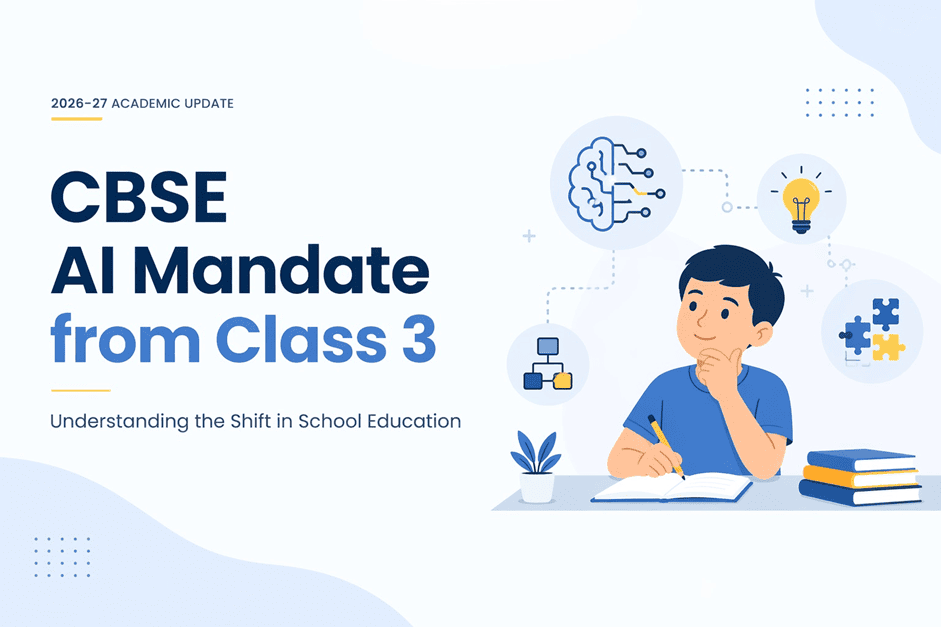


The Ministry of Education, through the Press Information Bureau, has announced the introduction of Artificial Intelligence (AI) and Computational Thinking (CT) from Class 3 onwards, to be implemented starting the 2026–27 academic session.
This initiative is aligned with the National Education Policy 2020 and the National Curriculum Framework 2023, reinforcing the shift toward competency-based and future-oriented education in India.
Positioning AI as a Foundational Skill
A key policy direction emerging from the announcement is the recognition of AI as a “basic universal skill”, rather than a specialized or elective subject.
This implies:
● Early exposure to structured thinking and problem-solving
● Integration of AI concepts into everyday learning contexts
● A focus on understanding and application, not technical complexity
The curriculum is designed to be linked with “The World Around Us (TWAU)”, ensuring that concepts are introduced through relatable, real-life scenarios.
Institutional Framework and Curriculum Development
The development and rollout of the AI and CT curriculum is being undertaken through a coordinated effort involving:
● Central Board of Secondary Education
● National Council of Educational Research and Training
● Kendriya Vidyalaya Sangathan
● Navodaya Vidyalaya Samiti
An expert committee constituted by CBSE, chaired by Karthik Raman, is responsible for designing the curriculum, ensuring academic rigor and alignment with national standards.
Implementation Timeline and Key Milestones
The rollout follows a structured timeline:
● Curriculum introduction: Academic session 2026–27
● Resource development: Completion targeted by December 2035
● Integration framework: Defined under NCF SE 2023
● Teacher training: Parallel rollout through structured programs
This phased approach reflects a planned and systematic transition, allowing institutions adequate time for preparation.
Teacher Enablement and Resource Development
The policy places strong emphasis on teacher preparedness as a critical success factor.
Implementation will be supported through:
● NISHTHA modules
● Video-based learning resources
● Grade-specific training frameworks
Teacher training is positioned as the backbone of effective classroom delivery, ensuring consistency and clarity in implementation.
Pedagogical Approach: Integration and Experiential Learning
At the primary level, AI and Computational Thinking will not be introduced as standalone subjects. Instead, they will be:
● Integrated within existing disciplines such as Mathematics and Environmental Studies
● Delivered through activity-based and experiential learning methods
● Designed to remain age-appropriate and non-burdensome
The focus is on developing:
● Logical reasoning
● Pattern recognition
● Structured problem-solving
● Awareness of AI in everyday life
Implementation Considerations in Schools
As schools across regions such as Hyderabad, Vijayawada, and Bengaluru prepare for implementation, certain practical considerations are emerging:
● Translating curriculum objectives into classroom-ready activities
● Ensuring consistency in delivery across grades
● Supporting educators with adequate training and resources
● Integrating new learning components within existing academic structures
These considerations highlight the importance of structured planning and execution frameworks.
The Role of Structured Learning Environments
To support effective delivery, there is an increasing shift toward structured, activity-driven learning environments within schools.
Such models typically include:
● Curriculum-aligned activity modules
● Hands-on learning setups for experiential engagement
● Teacher facilitation guides
● Ready-to-use classroom resources
In many cases, these are implemented through dedicated AI or innovation labs, which provide a controlled and scalable environment for delivering Computational Thinking and AI concepts in a practical manner.
Enabling Consistency and Scalability
Structured lab-based approaches help address key implementation needs by:
● Standardizing learning experiences across classrooms
● Reducing dependency on individual teacher preparation
● Supporting progressive, grade-wise learning pathways
● Ensuring alignment with curriculum objectives
These models are particularly effective at the primary level, where learning outcomes are closely linked to interaction, exploration, and guided activity.
The introduction of AI and Computational Thinking from Class 3 represents a system-level evolution in school education. With clearly defined timelines, institutional backing, and a focus on teacher enablement, the mandate is designed for gradual and meaningful integration.
Its effectiveness will depend on:
● Clarity in curriculum interpretation
● Strength of teacher support systems
● Adoption of structured, activity-based learning approaches
In this context, organizations such as Cognospace are contributing by developing integrated lab-based solutions that align with curriculum requirements while supporting practical classroom implementation.