Composite Skill Lab Conceptualization:
Why Schools Need Integrated Skill-Based Learning
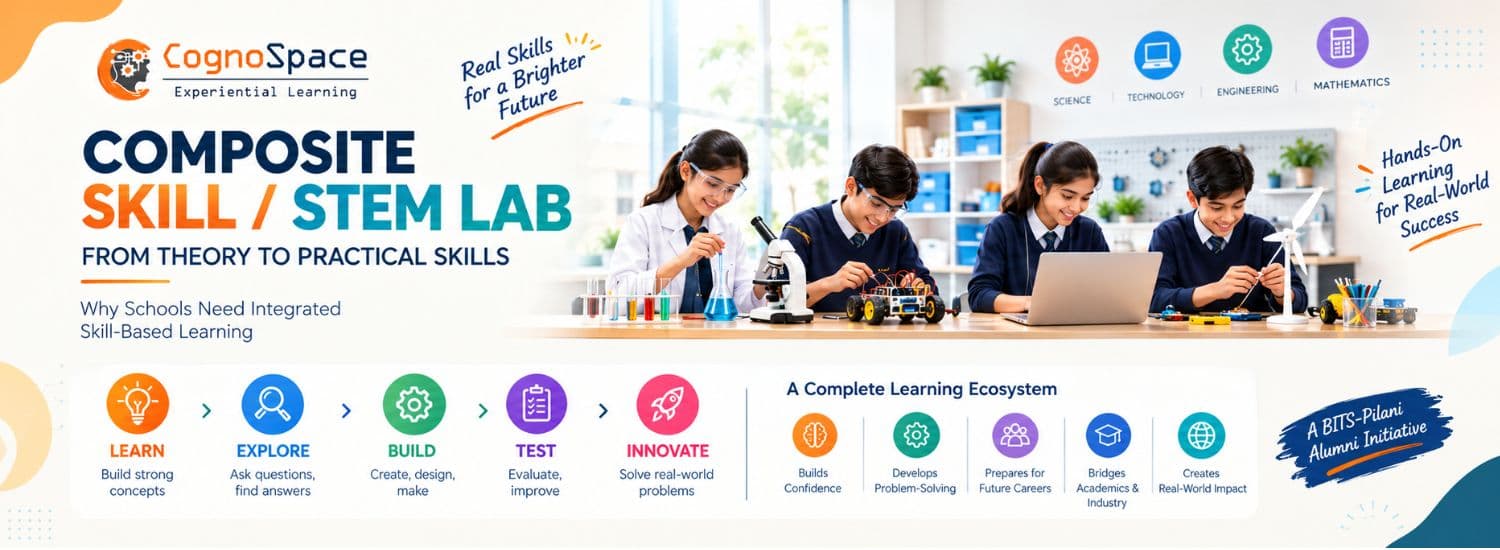


Students learn more effectively when they can connect what they learn in the classroom with practical experiences. Reading about a concept is important, but being able to experiment with it, build something, test an idea, and solve a problem can make learning much more meaningful.
This is the idea behind Composite Skill Lab conceptualization.
Instead of limiting learning to textbooks and lectures, a Composite Skill Lab gives students opportunities to experiment, build, design, test, collaborate, and solve real-world problems. It can bring STEM, robotics, engineering, technology, vocational skills, design thinking, coding, artificial intelligence, and project-based activities into one integrated learning environment.
For schools, this approach is particularly relevant as education increasingly focuses on experiential learning, competency development, vocational exposure, interdisciplinary learning, and 21st-century skills.
What Is a Composite Skill Lab?
A Composite Skill Lab is an integrated school learning space designed to provide students with practical, skill-oriented, and experiential learning opportunities across multiple domains.
Unlike a conventional subject-specific laboratory, it can combine different learning areas within one environment.
Depending on the school's requirements, a Composite Skill Lab may support:
- STEM activities
- Science experiments
- Mathematics applications
- Robotics and engineering
- Coding
- Artificial intelligence
- Electronics
- Design thinking
- Prototyping
- Vocational activities
- Entrepreneurship
- Creative projects
- Project-based learning
- Life skills
The objective is not simply to install equipment. The objective is to create a space where students can learn by doing.
CognoSpace Approach to Composite Skill Labs
CognoSpace approaches the Composite Skill Lab as a complete experiential learning ecosystem rather than simply a physical laboratory.
Its program combines a skill-based curriculum, Composite Skill/STEM Lab infrastructure, digital learning content, teacher training, assessments, and ongoing support. The brochure describes a program designed for Grades III–IX with 30+ modules and 650+ hands-on activities, covering STEM, engineering, technology, AI, and life skills.
This approach allows schools to bring practical learning into regular classroom experiences while giving students opportunities to explore concepts through activities and projects.
Why Were Composite Skill Labs Conceptualized?
The primary reason for Composite Skill Lab conceptualization is the need to bridge the gap between theoretical education and practical application.
Students may understand a concept during a lesson, but applying that concept to solve a problem requires a different set of skills.
For example, learning about electricity from a textbook is different from building a circuit, identifying an error, correcting it, and explaining how the circuit works.
A Composite Skill Lab creates opportunities for this type of learning.
It supports a transition from:
Theory → Practice → Experimentation → Problem-Solving → Skill Development
This approach makes education more connected to real-world situations.
What Is the Purpose of a Composite Skill Lab?
The purpose of a Composite Skill Lab for Schools is to provide students with structured opportunities to develop practical and transferable skills alongside academic knowledge.
Key objectives include:
- Connecting theory with practical application
- Encouraging hands-on learning
- Developing creativity and critical thinking
- Promoting problem-solving
- Supporting project-based learning
- Introducing students to technology
- Providing vocational exposure
- Encouraging interdisciplinary learning
- Supporting career exploration
- Developing future-ready skills
This makes the lab an educational ecosystem rather than simply another room in the school.
How Does a Composite Skill Lab Support NEP 2020?
The National Education Policy (NEP) 2020 emphasizes experiential learning, critical thinking, creativity, vocational exposure, multidisciplinary learning, and competency-based education.
This makes skill-oriented learning an important part of modern school education.
A Composite Skill Lab can provide the physical environment needed to put these educational principles into practice.
Students can learn through activities rather than only through theoretical instruction. They can work on projects, explore different tools and technologies, collaborate with peers, and develop practical capabilities.
CognoSpace's curriculum is designed around multidisciplinary and experiential learning, with its brochure highlighting alignment with NEP and NCF recommendations and applicability across CBSE, ICSE, Cambridge, and State Boards.
What Is Included in a Composite Skill Lab?
The exact infrastructure depends on the school's objectives, available space, student age groups, curriculum, and budget.
However, a well-planned Composite Skill Lab Setup may include:
STEM Learning
STEM activities allow students to apply science, technology, engineering, and mathematics concepts through practical projects.
Robotics and Engineering
Robotics activities can introduce students to mechanisms, electronics, sensors, programming, automation, mechanics, mechatronics, kinematics, hydraulics, IoT, and engineering concepts.
AI and Coding
Age-appropriate coding and AI activities can introduce students to computational thinking, algorithms, automation, artificial intelligence, and emerging technologies.
Design Thinking
Students can identify problems, brainstorm solutions, build prototypes, test their ideas, and improve their designs.
Vocational and Life Skills
Schools can introduce students to practical skills, financial awareness, personality development, and different areas of work, helping students understand the relationship between education, skills, and careers.
Project-Based Learning
Projects allow students to combine knowledge from different subjects to solve meaningful problems.
How CognoSpace Organizes These Learning Areas
The CognoSpace curriculum is structured into four broad areas:
- Conceptual Learning – Science, Mathematics, Arts Integration, and Computational Thinking
- Robotics & Engineering – Mechatronics, Kinematics, Mechanics, IoT, Hydraulics, Drones, and related engineering activities
- Technology & AI – Artificial Intelligence, Virtual Reality, 3D Printing, App Development, and technology-focused learning
- Arts & Life Skills – Kaushal Bodh, Personality Development, Financial Literacy, and Design Thinking
The brochure identifies 30+ sub-modules and 650+ activities for Grades III–IX, giving schools a structured framework for practical learning.
What Equipment Does a Composite Skill Lab Need?
Composite Skill Lab Equipment should be selected according to learning objectives rather than simply filling the laboratory with advanced tools.
Depending on the modules, schools may require:
- STEM learning kits
- Robotics and engineering kits
- Electronics components
- Sensors
- Motors
- Mechanical components
- Coding resources
- Science and mathematics concept kits
- Prototyping materials
- Design tools
- Digital learning resources
- Fabrication resources
- 3D printing equipment
- Safety equipment
- Storage systems
- Student workstations
CognoSpace's lab infrastructure includes workstations, presentation facilities, robotics and engineering kits, a 3D printer, STEM models, tablets, storage units, and other resources designed to support hands-on learning.
The right Skill Lab Equipment for Schools should be age-appropriate, safe, durable, curriculum-aligned, and practical for regular classroom use.
How Is a Composite Skill Lab Different From a STEM Lab?
A STEM Lab for Schools generally focuses on science, technology, engineering, and mathematics.
A Composite Skill Lab can have a broader scope.
It may incorporate STEM along with robotics, engineering, vocational learning, design thinking, coding, AI, entrepreneurship, creativity, and life skills.
| STEM Lab | Composite Skill Lab |
|---|---|
| Primarily STEM-focused | Multi-domain learning |
| Science and technology activities | STEM + robotics + engineering + skills + technology |
| Subject-focused experimentation | Integrated skill development |
| STEM projects | Interdisciplinary projects |
| Technical exploration | Technical + creative + practical skills |
The two concepts can complement each other rather than being treated as competing models.
How Does a Composite Skill Lab Promote Experiential Learning?
Experiential Learning happens when students learn through direct experiences, reflection, experimentation, and application.
A Composite Skill Lab naturally supports this model.
For example, instead of simply explaining how a bridge works, a teacher could ask students to design and build a small bridge using available materials.
Students then:
Understand → Design → Build → Test → Identify Problems → Improve
The learning becomes an experience rather than just information.
CognoSpace's Experiential Learning Flow
CognoSpace structures its lab sessions around a combination of visual learning, hands-on activity, reflection, evaluation, and post-session learning.
Its session model includes videos for topics, activity instructions and manuals, hands-on work with resources, assessments, public speaking, and take-home activities supported through its learning platform.
This creates a more continuous learning cycle instead of treating laboratory activities as isolated demonstrations.
Why Is Hands-on Learning Important?
Hands-on Learning gives students the opportunity to physically interact with concepts.
When students build a model, assemble a robot, conduct an experiment, create a prototype, or solve a practical challenge, they engage with learning at multiple levels.
Hands-on activities can help students:
- Understand concepts more clearly
- Develop problem-solving abilities
- Improve collaboration
- Build confidence
- Encourage curiosity
- Learn from mistakes
- Apply knowledge
- Develop creativity and innovation
A well-designed Practical Learning Environment makes these experiences part of regular education rather than occasional activities.
How Can Composite Skill Labs Support Career Exploration?
Students often hear about careers without actually experiencing the skills associated with them.
A Composite Skill Lab can provide early exposure to different areas.
For example:
- Robotics can introduce engineering concepts.
- Coding can introduce software and technology.
- Design projects can introduce product development.
- Electronics can introduce automation.
- Entrepreneurship activities can introduce business thinking.
- AI projects can introduce emerging technologies.
- Financial literacy can introduce practical money-management concepts.
This creates opportunities for Career Exploration for Students.
The goal is not to make students choose a career at an early age. Instead, students can discover their interests and strengths through meaningful experiences.
How Does a Composite Skill Lab Build Future-Ready Skills?
The workplace is changing rapidly, and students need capabilities that can transfer across different careers.
A Composite Skill Lab can support the development of:
- Critical thinking
- Creativity
- Communication
- Collaboration
- Problem-solving
- Decision-making
- Digital literacy
- Adaptability
- Project management
- Innovation
These capabilities contribute to Career-Ready Skills and Future-Ready Education.
CognoSpace's program specifically focuses on outcomes such as conceptual clarity, logical thinking, visualization, curiosity, problem-solving, design thinking, engineering skills, innovation, digital fluency, AI literacy, creativity, collaboration, and real-world readiness.
What Is the Role of Design Thinking?
Design Thinking for Students provides a structured way to approach problems.
A typical process involves:
Empathize → Define → Ideate → Prototype → Test → Improve
For example, students could be asked to find a way to reduce water wastage in their school.
Instead of receiving a ready-made solution, they investigate the problem, discuss possible approaches, create a prototype, test it, and improve it.
This encourages students to become problem-solvers rather than passive learners.
Design thinking is also included within CognoSpace's skill-based curriculum alongside technology, AI, STEM, and life-skills learning.
How Can Schools Set Up a Composite Skill Lab?
A successful Skill Lab Setup for Schools should begin with educational objectives.
Step 1: Identify the Learning Goals
Decide which skills, subjects, technologies, and activities the school wants to introduce.
Step 2: Assess the Available Space
Evaluate room size, electrical requirements, storage, safety, furniture, and student capacity.
Step 3: Select Learning Modules
Choose appropriate modules covering STEM, robotics, engineering, coding, vocational learning, design thinking, AI, life skills, or other areas.
Step 4: Select Equipment
Choose School Lab Equipment based on curriculum relevance, student age, safety, durability, and frequency of use.
Step 5: Train Teachers
Teachers need practical training to conduct activities, manage equipment, guide projects, and assess student learning.
CognoSpace provides schools with faculty training or the option of deploying a trained educator to support the execution of sessions.
Step 6: Integrate Activities With the Curriculum
The lab should be connected to classroom learning instead of being used only for occasional demonstrations.
Step 7: Monitor Student Progress
Schools can use projects, assessments, portfolios, presentations, and observations to track skill development.
CognoSpace also provides assessment and progress-support mechanisms, including learning profiles, mid-year and end-of-year assessments, and a progress dashboard for school management.
What Makes a Composite Skill Lab Successful?
Infrastructure alone does not make a successful skill lab.
The effectiveness of a Composite Skill Lab in Schools depends on several factors:
Relevant curriculum + appropriate equipment + trained teachers + regular activities + student participation + assessment
A school may have sophisticated equipment, but if students rarely use it, the educational value remains limited.
The lab should therefore become part of the school's regular learning ecosystem.
This is why a complete implementation model can be more useful than infrastructure alone. CognoSpace includes ongoing lab maintenance, support, restocking of consumables, relationship management, digital content, and teacher support as part of its program.
Composite Skill Lab and Vocational Education
One of the important aspects of skill-oriented education is introducing students to practical work and different career domains.
A Vocational Skill Lab can help students understand how skills are used in real-world situations.
This can contribute to the broader objectives of Vocational Education in Schools, while also encouraging students to appreciate different types of work and career pathways.
When vocational exposure is combined with STEM, technology, design, entrepreneurship, financial literacy, and life skills, schools can create a broader Multi-Sector Learning Environment.
How CognoSpace Supports Schools Beyond the Lab
Setting up a lab is only the beginning. For experiential learning to become sustainable, schools also need curriculum planning, teacher support, assessments, and regular execution.
CognoSpace's model includes several elements designed to support this process:
- Skill-focused curriculum
- Composite Skill/STEM Lab infrastructure
- Digital learning content through an LMS
- Faculty training or trained educators
- Dedicated Relationship Manager
- Weekly delivery planning
- Assessments and learning profiles
- STEM competitions and external competition support
- Certificates for innovation and skill development
- Complete lab maintenance
- 24/7 on-call support
These services are intended to help schools move from simply having a laboratory to actually using it as an active learning environment.
Conclusion: From Learning to Doing
A classroom can provide knowledge. A textbook can explain a concept. A teacher can demonstrate an activity.
But a well-designed skill lab allows students to experience the concept themselves.
They can build, test, fail, redesign, collaborate, and try again.
That is the real value of a Composite Skill Lab for Schools looking to strengthen practical and skill-based education.
CognoSpace's approach demonstrates how curriculum, infrastructure, hands-on activities, technology, teacher support, assessments, and ongoing maintenance can come together to create a structured experiential learning environment.
The future of education is not about choosing between academic learning and practical learning. It is about bringing both together.
When students learn by doing, knowledge becomes experience—and experience becomes skill.
Frequently Asked Questions
What is a Composite Skill Lab?
A Composite Skill Lab is an integrated school learning space that provides practical and skill-based learning across multiple areas such as STEM, robotics, engineering, technology, design thinking, vocational skills, life skills, and project-based learning.
Why were Composite Skill Labs conceptualized?
They were conceptualized to bridge the gap between theoretical education and practical application and to provide students with opportunities to develop practical, creative, technical, and problem-solving skills.
Is a Composite Skill Lab only for CBSE schools?
No. The concept can be adapted by different types of schools. A well-designed Composite Skill Lab can support different curricula depending on the school's learning objectives and requirements. CognoSpace states that its curriculum is designed for CBSE, ICSE, Cambridge, and State Boards.
What equipment is required for a Composite Skill Lab?
Requirements vary by school, but equipment can include STEM kits, robotics and engineering kits, electronics components, sensors, mechanical components, coding resources, prototyping materials, 3D printers, digital resources, STEM models, and safety equipment.
What is the difference between a STEM Lab and a Composite Skill Lab?
A STEM lab primarily focuses on science, technology, engineering, and mathematics. A Composite Skill Lab can have a broader scope by combining STEM with robotics, engineering, vocational learning, design thinking, coding, AI, life skills, creativity, and other skill-based areas.
How does a Composite Skill Lab help students?
It gives students opportunities to learn through practical activities and projects while developing problem-solving, creativity, collaboration, communication, critical thinking, technical awareness, and other future-ready capabilities.
What does CognoSpace provide along with its Composite Skill/STEM Lab?
CognoSpace provides a combination of lab infrastructure, skill-based curriculum, hands-on activities, digital learning content, teacher training for educators, assessments, ongoing support, and lab maintenance. Its brochure states that the program includes 30+ modules and 650+ activities for Grades III–IX.