
Composite Skill Lab Setup Guide:
Planning, Equipment and Implementation in Phases
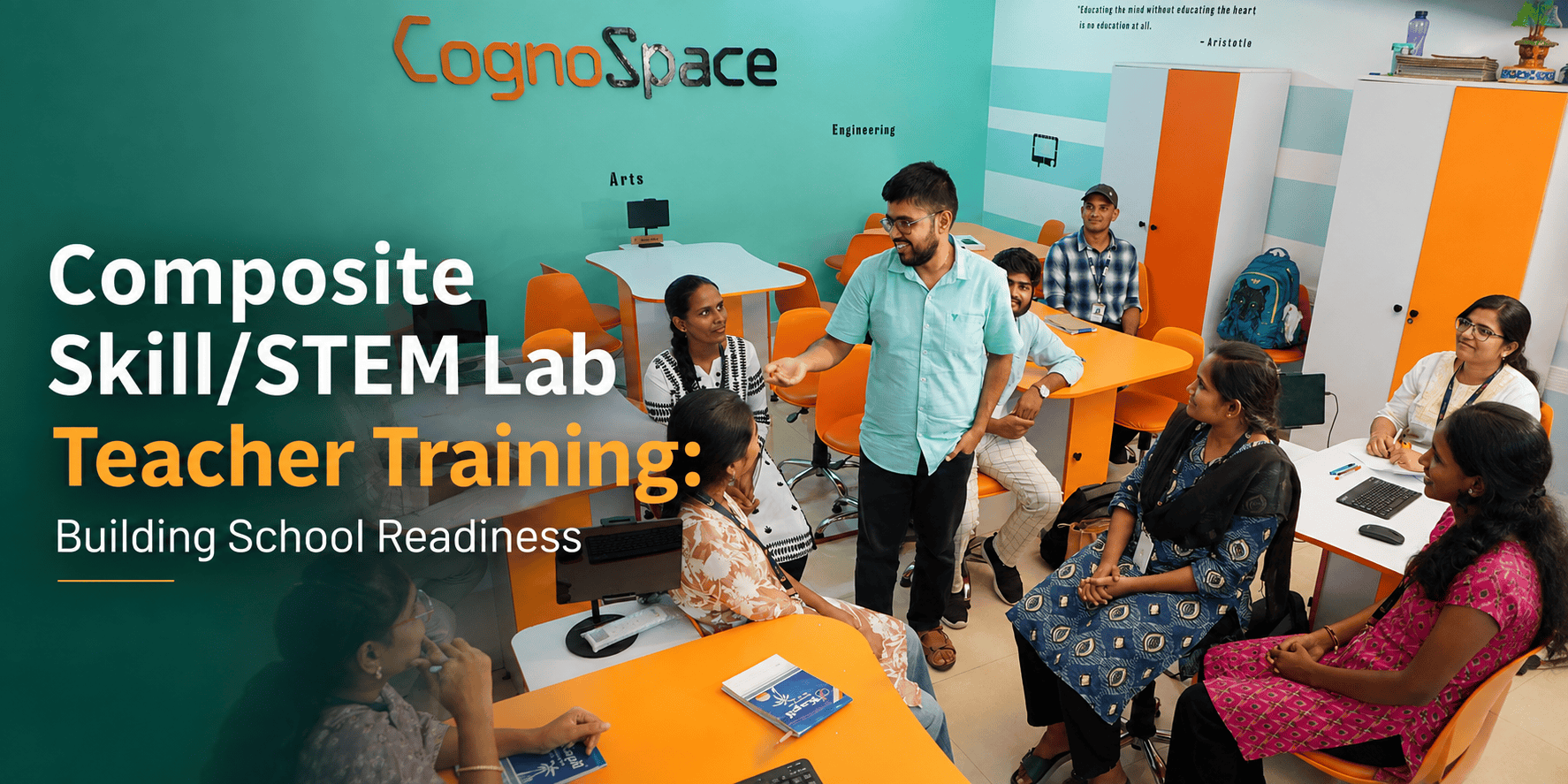


Schools are increasingly looking for ways to make learning more practical, engaging, and connected to the real world. While classroom teaching helps students understand concepts, hands-on experiences give them an opportunity to apply what they have learned.
This is where a Composite Skill Lab can make a difference.
A composite skill lab brings together practical learning areas such as science, mathematics, STEM, robotics, engineering, coding, artificial intelligence, IoT, design thinking, and life skills in one structured learning environment.
However, setting up a successful skill lab is not simply about purchasing kits and placing them in a classroom. Schools need to consider infrastructure, furniture, equipment, curriculum, teacher training, student engagement, assessments, maintenance, and ongoing support.
CognoSpace approaches composite skill lab implementation as a complete learning ecosystem, combining lab infrastructure with a multidisciplinary curriculum, hands-on activities, digital resources, teacher support, assessments, and maintenance.
In this guide, let's explore how schools can plan a Composite Skill Lab Setup in India, step by step, and understand how CognoSpace can support the journey from initial planning to long-term implementation.
What Is a Composite Skill Lab?
A Composite Skill Lab is a dedicated practical learning space where students can explore concepts through experiments, activities, projects, models, and real-world problem-solving.
Instead of restricting practical learning to one subject, a Composite Skill Lab for Schools can connect multiple disciplines.
For example, students may learn about force and motion in science and then explore the same principles through an engineering model. They might learn mathematical concepts and use physical models to visualise them. Similarly, coding concepts can be connected with robotics, IoT, or automation projects.
The purpose is to help students move through a simple learning cycle:
Learn → Explore → Build → Test → Improve → Reflect
Depending on the school's requirements, a composite skill lab may include:
- Science
- Mathematics
- STEM
- Robotics
- Engineering
- Coding
- Artificial Intelligence
- IoT
- Computational thinking
- 3D printing
- Design thinking
- Financial literacy
- Communication
- Life skills
CognoSpace follows a multidisciplinary approach that combines conceptual learning, robotics and engineering, technology and AI, and arts and life skills within its skill and STEM lab ecosystem.
Why Should Schools Set Up a Composite Skill Lab in Phases?
Setting up a Composite Skill Lab involves several activities that need to work together.
The school has to plan the room, select equipment, create an activity-based curriculum, prepare teachers, schedule student sessions, maintain resources, and measure learning outcomes.
Trying to handle all of these at the same time can make implementation complicated.
A phased approach gives school management a clear roadmap.
A practical implementation can be divided into six phases:
- Readiness Assessment
- Planning and Lab Design
- Infrastructure and Equipment Setup
- Curriculum and Teacher Preparation
- Student Launch
- Assessment and Continuous Improvement
Let's look at each phase in detail.
Phase 1: Assess Composite Skill Lab Readiness
Before buying equipment, schools should first understand what they already have and what they actually need.
This is the Composite Skill Lab Readiness stage.
The school should assess the available space, infrastructure, grades, student strength, teachers, timetable, and learning objectives.
1. Evaluate the Available Space
The first step is identifying a suitable room.
Students need enough space to move around, work in groups, conduct experiments, and build projects.
The room should ideally accommodate:
- Student workstations
- Group activities
- Equipment
- Storage
- Demonstration areas
- Project work
- Display models
- Teacher supervision
CognoSpace's lab infrastructure approach includes dedicated workstations and storage facilities to support practical learning and organised equipment management.
A flexible layout is particularly useful because the same room may be used for science activities one day and robotics or engineering projects on another.
2. Check Existing Infrastructure
Before starting the Skill Lab Setup, schools should review the basic infrastructure available in the selected room.
This can include:
- Electrical points
- Lighting
- Ventilation
- Internet connectivity
- Storage
- Work surfaces
- Presentation facilities
- Safety arrangements
Technology-based activities may require additional electrical and connectivity planning. The requirements will depend on the curriculum and equipment selected for the lab.
3. Identify Grades and Student Strength
The requirements of a lab for primary students may differ considerably from those of a lab designed for middle-school students.
Schools should determine:
- Which grades will use the lab?
- How many students will participate?
- How frequently will sessions take place?
- How many students will work at each workstation?
- Which subjects will be integrated?
CognoSpace's curriculum is designed for students in Grades III–IX, with multidisciplinary learning experiences spanning STEM, engineering, technology, AI, robotics, and life skills.
Understanding the student profile early helps schools plan the number of kits, workstations, tools, and resources required.
4. Identify Teacher Requirements
Teachers are one of the most important parts of successful Skill-Based Learning in Schools.
Schools should identify educators who will coordinate lab sessions and determine what training they need.
The objective should not simply be to teach teachers how to operate equipment. Teachers should also understand how to use activities to explain concepts, guide projects, encourage teamwork, and assess student learning.
CognoSpace incorporates faculty training and educator-support options into its implementation approach.
Phase 2: Plan the Composite Skill Lab
Once the school's readiness has been assessed, the next step is Composite Skill Lab Planning.
A good lab should be designed around student learning rather than simply around the equipment that needs to be purchased.
Before finalising the layout, school leaders can ask:
- What should students learn?
- What skills should they develop?
- What activities will they perform?
- Which subjects should be integrated?
- How many students will use the lab at one time?
- What storage will be required?
- How will teachers demonstrate activities?
The answers to these questions can guide the overall Composite Skill Lab Design.
Create Different Learning Zones
Depending on the school's requirements, a composite lab can have different learning zones.
Science and Mathematics
Students can use models, experiments, puzzles, and practical activities to explore scientific and mathematical concepts.
Hands-on models can be particularly useful for helping students visualise concepts that may otherwise feel abstract.
Robotics and Engineering
Robotics and engineering activities can introduce students to concepts such as:
- Mechanics
- Kinematics
- Mechatronics
- Structural engineering
- Hydraulics
- IoT
- Drones
CognoSpace integrates robotics and engineering into its multidisciplinary curriculum, allowing students to explore technical concepts through practical activities and projects.
Technology and Artificial Intelligence
Technology-focused activities may introduce students to:
- Coding
- Artificial Intelligence
- Computational Thinking
- IoT
- Virtual Reality
- 3D Printing
- App Development
These activities can give students opportunities to understand how technology is used to solve practical problems.
Design Thinking and Life Skills
A modern skill lab can also extend beyond STEM.
Activities can include:
- Design thinking
- Financial literacy
- Communication
- Collaboration
- Personality development
- Life skills
CognoSpace's curriculum includes technology and AI alongside arts and life skills, creating a broader multidisciplinary learning experience.
Plan the Furniture and Workstations
Composite Skill Lab Furniture should be selected according to the activities students will perform.
Students may work with robotics components, electronics, science models, construction materials, and other resources. Therefore, workstations should provide enough room for practical activities.
Storage should also be considered from the beginning.
Kits, tools, and components should have dedicated storage areas so students and teachers can quickly find and return resources.
CognoSpace's infrastructure model includes workstations, storage units, cabinets, and other facilities designed to support organised hands-on learning.
Phase 3: Select Composite Skill Lab Equipment
Once the lab design is established, schools can move on to equipment selection.
This is one of the most important parts of the Composite Skill Lab Setup.
A useful approach is to start with learning objectives rather than product lists.
Instead of asking: "What equipment should we buy?", ask: "What should students be able to learn and create with this equipment?"
The equipment can then be selected accordingly.
Depending on the school's requirements, Composite Skill Lab Equipment may include:
- Science concept kits
- Mathematics activity kits
- STEM models
- Robotics kits
- Engineering kits
- Electronics components
- IoT resources
- Coding resources
- 3D printers
- Tablets
- Workstations
- Tools
- Books and lab manuals
- Digital learning resources
- Presentation equipment
CognoSpace's lab infrastructure includes science and mathematics concept kits, robotics and engineering kits, STEM models, tablets, workstations, books and lab manuals, 3D printing resources, and digital learning support.
Why Consumables Matter
A common mistake schools make while planning a lab is focusing only on major equipment.
Many practical activities also require consumable materials and replacement components.
Schools should therefore plan for:
- Electronic components
- Construction materials
- Project resources
- Activity consumables
- Replacement parts
- Regular replenishment
Consumables should be included as part of the Composite Skill Lab Requirements.
CognoSpace's support model includes stocking and restocking consumables according to implementation requirements, helping schools maintain continuity in practical activities.
Phase 4: Build the Curriculum and Prepare Teachers
Infrastructure creates the physical environment, but curriculum creates the learning experience.
A CBSE Skill Lab should therefore provide structured activities that connect classroom concepts with practical applications.
Students should not simply be given a kit and told to build something. They should understand:
- What are we learning?
- Why does it matter?
- How does it work?
- What can we create with it?
CognoSpace follows a multidisciplinary curriculum approach that combines conceptual learning with hands-on activities across STEM, engineering, robotics, AI, technology, arts, and life skills.
What Can Students Learn?
Science and Mathematics
Students can explore scientific principles and mathematical concepts through experiments, models, demonstrations, and activities.
For example, a mathematical model can help students visualise geometry, while a science activity can allow them to observe a concept instead of only reading about it.
Robotics and Engineering
Students can progressively explore engineering concepts by designing and building models.
Activities can introduce concepts such as:
- Mechanisms
- Motion
- Structures
- Electronics
- Robotics
- Automation
- Sensors
- Engineering design
The focus is on allowing students to learn through experimentation and problem-solving.
AI, Coding and Technology
Students can explore emerging technologies through activities involving:
- Coding
- AI
- Computational thinking
- IoT
- 3D printing
- Virtual Reality
- App development
These activities can help students develop logical thinking and understand how technology can be applied to real-world challenges.
Life and Future Skills
Students also need skills beyond technical knowledge.
A composite skill lab can provide opportunities to develop:
- Creativity
- Communication
- Collaboration
- Financial awareness
- Presentation skills
- Design thinking
- Problem-solving
This is one of the advantages of an integrated learning model such as the one offered by CognoSpace.
Teacher Training: The Key to Successful Skill Lab Implementation
A lab can have excellent equipment and still remain underused if teachers do not receive adequate preparation.
Teacher training should cover more than equipment operation.
Teachers should understand how to:
- Conduct practical activities
- Explain concepts
- Guide student groups
- Manage the lab
- Follow safety procedures
- Support project work
- Encourage problem-solving
- Assess student learning
- Handle basic troubleshooting
CognoSpace includes faculty training or trained educator support as part of its implementation approach.
This can help schools integrate the lab into their academic routine instead of using it only for occasional demonstrations.
Phase 5: Launch the Composite Skill Lab
Once infrastructure, equipment, curriculum, and teacher preparation are ready, the school can begin student implementation.
However, launching the lab should not simply mean holding an inauguration event.
The real objective is to establish regular student usage.
Begin With Student Orientation
Students should first understand:
- The purpose of the lab
- How to use the equipment
- Basic safety procedures
- Where resources are stored
- How to work in teams
- How to maintain the workspace
- How to handle tools responsibly
This initial orientation can make students more comfortable with the environment.
Start With Guided Activities
Students do not need to start with highly complex projects.
A gradual progression can work well:
Step 1: Follow a structured activity
↓
Step 2: Modify the activity
↓
Step 3: Solve a practical challenge
↓
Step 4: Design an independent project
This allows students to develop confidence before moving toward more open-ended problem-solving.
How a CognoSpace Lab Session Can Work
CognoSpace describes a structured learning flow for its lab sessions that combines visual learning, hands-on activities, reflection, evaluation, and continued learning.
A typical 45-minute session can be understood as:
- Introduction: The teacher introduces the topic and explains the objective.
- Visual Learning: Students watch a video, demonstration, or visual explanation.
- Experiential Activity: Students work individually or in teams to complete a hands-on activity.
- Reflection: Students discuss their observations and explain what they learned.
- Evaluation: Teachers assess understanding through questions, demonstrations, or activity outcomes.
- Continued Learning: Students can revisit resources for preparation, revision, or further exploration.
This approach creates a complete learning cycle rather than treating each practical activity as a standalone task.
Phase 6: Assess, Maintain and Improve
The implementation of a Composite Skill Lab in Schools does not end once students complete their first activity.
The lab needs continuous monitoring and improvement.
Schools should regularly review both student learning and the condition of the equipment.
Measure Student Learning
Schools can track different learning outcomes, including:
- Conceptual understanding
- Logical thinking
- Problem-solving
- Creativity
- Design thinking
- Technical skills
- Collaboration
- Communication
- Innovation
- Project development
Assessment can take different forms:
- Practical demonstrations
- Project reviews
- Activity-based assessments
- Presentations
- Quizzes
- Teacher observations
- Periodic assessments
CognoSpace's implementation model includes learning profiles, outcomes, assessments, and progress dashboards to help schools monitor student development.
Maintain the Lab Regularly
A practical learning environment requires regular maintenance.
Schools should establish systems for:
- Equipment checks
- Repair and replacement
- Consumable replenishment
- Storage management
- Safety checks
- Digital resource updates
- Kit maintenance
CognoSpace's support model includes repair and replacement support for lab infrastructure, gadgets, and kits, along with consumable stocking and restocking according to requirements.
This can help schools keep the lab functional throughout the academic year.
How CognoSpace Supports Composite Skill Lab Setup
For schools that want more than a room filled with equipment, an integrated implementation model can bring the different parts of a skill lab together.
CognoSpace's approach combines several components:
1. Complete Lab Infrastructure
The infrastructure includes resources such as workstations, storage units, cabinets, STEM models, science and mathematics kits, robotics and engineering kits, tablets, 3D printing resources, and presentation facilities.
2. Multidisciplinary Curriculum
CognoSpace brings together science, mathematics, STEM, robotics, engineering, coding, AI, computational thinking, IoT, design thinking, arts, and life skills across 30+ modules and 650+ activities for Grades III–IX.
3. Digital Learning Resources
Digital content, videos, activity instructions, and learning resources can support classroom and laboratory activities. CognoSpace also provides a Learning Management System as part of its broader learning ecosystem.
4. Teacher Training
Schools can prepare their own faculty through training or explore trained educator support depending on their implementation requirements.
5. Implementation Support
A dedicated support structure can help schools with delivery planning, implementation questions, and ongoing coordination.
6. Assessments and Progress Tracking
The implementation model includes assessments, learning profiles, student outcomes, and school-management progress dashboards.
7. Maintenance and Consumables
Repair, replacement, maintenance, and consumable replenishment help support the lab after the initial setup.
Composite Skill Lab Requirements Checklist
Before beginning a Composite Skill Lab Setup for Schools, school leaders can use this checklist:
| Requirement | What to Consider |
|---|---|
| Space | Room size, movement and activity areas |
| Infrastructure | Electricity, lighting, ventilation and connectivity |
| Furniture | Workstations, storage and cabinets |
| Equipment | Science, mathematics, STEM, robotics and technology resources |
| Curriculum | Age-appropriate hands-on activities |
| Teachers | Training and activity implementation |
| Digital Resources | LMS, videos and activity instructions |
| Safety | Supervision and equipment handling |
| Consumables | Activity materials and replacement components |
| Assessment | Student learning and skill development |
| Maintenance | Repairs and replacements |
| Support | Ongoing implementation assistance |
This checklist shows why a composite skill lab should be viewed as a complete learning ecosystem rather than simply a collection of kits.
What Factors Affect Composite Skill Lab Cost?
The Composite Skill Lab Cost can vary from school to school.
There is no single setup that fits every institution because the requirements can be different.
Factors that can influence the investment include:
- Size of the lab
- Number of students
- Number of workstations
- Grades covered
- Curriculum scope
- Number and type of kits
- Robotics and engineering equipment
- Technology resources
- Furniture
- Digital resources
- Teacher training
- Consumables
- Maintenance
- Ongoing support
Schools should therefore define their requirements before comparing different proposals.
It is also useful to look beyond the initial equipment price and consider the complete implementation:
Infrastructure + Curriculum + Activities + Teacher Training + Assessment + Maintenance + Support
This gives school management a better understanding of the overall solution.
A Six-Phase Composite Skill Lab Setup Roadmap
Schools can use this simple roadmap when planning their implementation:
1. READINESS
Assess the space, infrastructure, grades, students, teachers, and learning objectives.
↓
2. PLANNING
Define learning areas, curriculum, activities, furniture, storage, and lab layout.
↓
3. SETUP
Install workstations, equipment, kits, technology, storage, and other resources.
↓
4. PREPARATION
Train teachers and prepare a regular timetable for lab sessions.
↓
5. LAUNCH
Orient students and begin structured practical learning activities.
↓
6. IMPROVEMENT
Monitor student outcomes, maintain resources, replenish consumables, and improve activities continuously.
CognoSpace can support schools across these stages through its combination of infrastructure, curriculum, training, digital resources, assessments, and ongoing implementation support.
Why Experiential Learning Matters
The real purpose of a Skill Lab for Schools is not simply to give students access to equipment.
It is to change the way they experience learning.
When students build something, test it, discover a problem, make changes, and try again, they learn from the entire process.
This is the value of Experiential Learning.
A practical learning environment can encourage students to:
- Ask questions
- Explore ideas
- Experiment
- Make mistakes safely
- Test solutions
- Work with peers
- Present their projects
- Reflect on their learning
- Apply classroom knowledge
For example, instead of only reading about a mechanical system, students can build a simple mechanism and observe how changing one component affects the outcome.
Instead of learning coding only through theory, students can create a small project and troubleshoot it when the expected result does not appear.
These experiences can help students understand the connection between knowledge and application.
Frequently Asked Questions About Composite Skill Labs
1. What is a Composite Skill Lab in schools?
A Composite Skill Lab is an integrated practical learning environment where students explore multiple subjects and skills through hands-on activities, experiments, projects, and technology.
2. What equipment is required for a Composite Skill Lab?
Requirements vary according to the school's curriculum and student age. Equipment may include science and mathematics kits, STEM models, robotics and engineering kits, coding resources, IoT components, tablets, 3D printers, workstations, tools, and digital learning resources.
3. Which grades can use a Composite Skill Lab?
The appropriate grades depend on the curriculum and activities. CognoSpace's multidisciplinary curriculum covers Grades III–IX.
4. Is teacher training required for a Composite Skill Lab?
Yes. Teachers need to understand how to conduct activities, use equipment safely, manage student groups, guide projects, and assess learning outcomes.
5. How does CognoSpace support schools?
CognoSpace combines lab infrastructure, multidisciplinary curriculum, hands-on activities, digital resources, teacher training or educator support, assessments, maintenance, and ongoing implementation support.
Conclusion
Setting up a CBSE Composite Skill Lab is not a one-time equipment purchase. It is a process that involves planning, infrastructure, curriculum, teacher preparation, student engagement, assessment, and continuous maintenance.
A phased approach makes the process easier to manage.
Schools can begin by assessing their readiness, planning the learning environment, selecting the right Composite Skill Lab Equipment, developing an activity-based curriculum, preparing teachers, launching student sessions, and establishing systems for assessment and maintenance.
For schools looking for an integrated Composite Skill Lab Setup for Schools, CognoSpace brings together the physical infrastructure and the learning ecosystem required to support practical education.
From STEM, science and mathematics to robotics, engineering, AI, coding, IoT, design thinking, and life skills, the aim is to provide students with opportunities to learn through doing.
Ultimately, the success of a skill lab is not measured by how many kits are placed inside the room.
It is measured by what students do with those resources.
A well-planned lab can become a place where students ask questions, experiment with ideas, build models, solve problems, collaborate with classmates, and turn concepts from their textbooks into practical experiences.