
Composite Skill Lab Setup: Tools and Equipment
for CBSE Schools
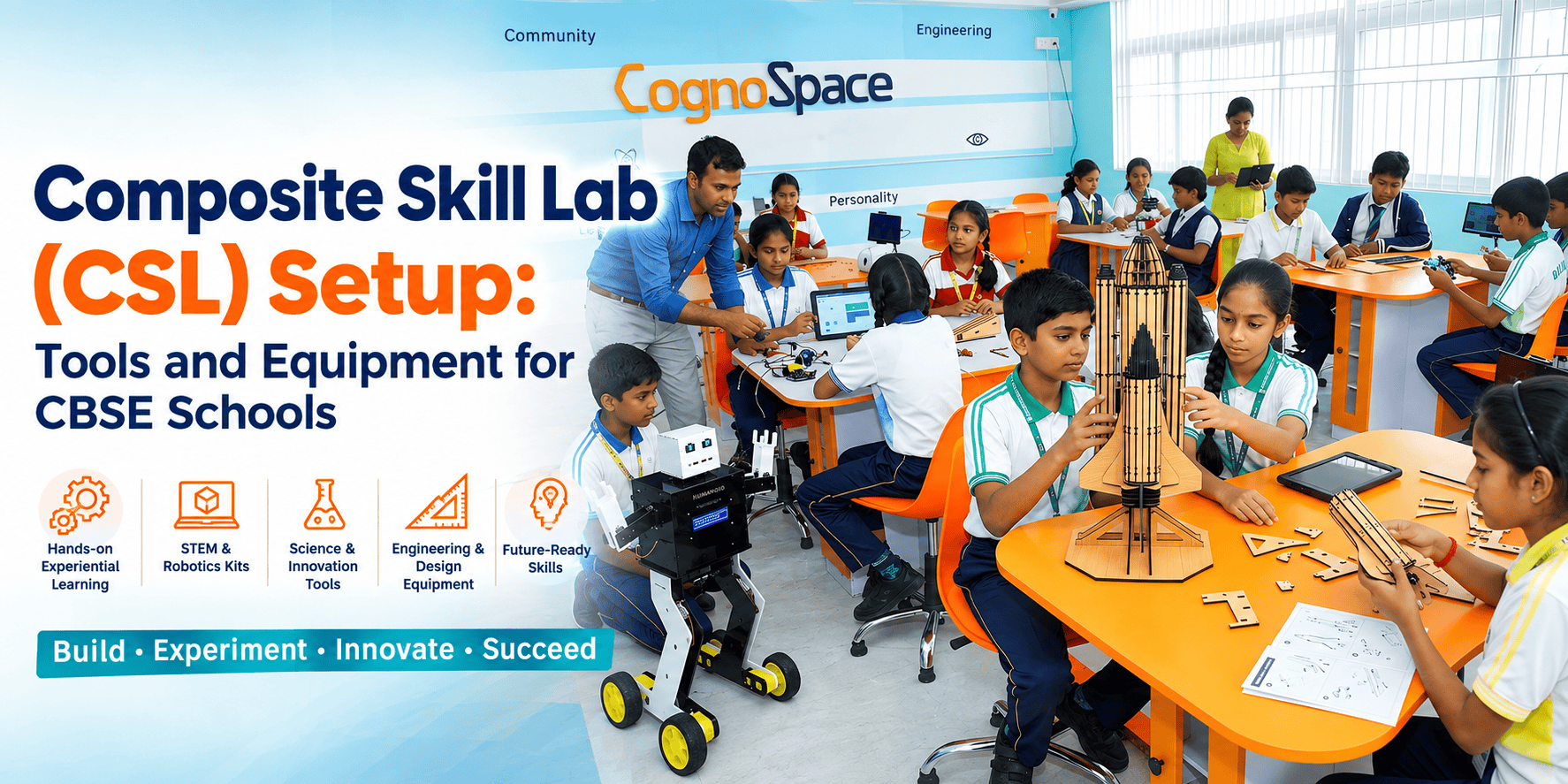


When a school decides to set up a Composite Skill Lab (CSL), one of the first questions usually comes up is: What tools and equipment do we actually need?
The answer is not simply a long list of machines, kits and materials.
A good Composite Skill Lab (CSL) should give students opportunities to experiment, build, test, troubleshoot and apply what they learn in the classroom.
This is the approach followed by CognoSpace Composite Skill Labs, where equipment and activities are planned around experiential learning across Science, Mathematics, Robotics & Engineering, Technology and Life Skills.
For schools, this means the focus is not only on what equipment is placed inside the lab, but also on what students can do with it.
What Is a Composite Skill Lab (CSL)?
A Composite Skill Lab (CSL) is a practical learning environment where students learn concepts through activities, experiments, making and problem-solving.
Instead of only reading about how a pulley works, students can build one.
Instead of only discussing circuits, they can create one.
Instead of learning about robotics theoretically, they can assemble a mechanism and observe how movement is produced.
This is the basic idea behind CognoSpace Composite Skill Labs.
The CognoSpace curriculum for Grades 1–9 combines hands-on Science and Mathematics activities with areas such as Robotics & Engineering, Mechatronics, Tinkering, Design Thinking, AI, IoT/Automation, 3D Printing and Life Skills.
So, a CBSE Composite Skill Lab (CSL) should be thought of as a learning environment rather than simply an equipment room.
Why Composite Skill Lab (CSL) Tools Matter
Imagine a teacher explaining friction to a class.
Students can read the definition, write the formula and answer questions.
But what happens when students can actually test friction using different materials?
They begin asking different questions:
- Why does one surface move more easily?
- What happens when the weight changes?
- Why does the result change with another material?
This is where Composite Skill Lab (CSL) tools become valuable.
The right tools allow teachers to convert abstract concepts into practical experiences.
CognoSpace follows this approach through hands-on activities that connect classroom concepts with real-life situations. The curriculum includes more than 120 Science and Mathematics activities across Grades 1–9.
What Equipment Is Needed for a Composite Skill Lab (CSL)?
There is no single equipment package that will work equally well for every school.
A school should consider:
- Grades using the lab
- Number of students
- Curriculum activities
- Available space
- Teacher requirements
- Safety requirements
- Storage
- Maintenance
- Level of technology required
The Composite Skill Lab (CSL) equipment should then be selected around those requirements.
For example, equipment required for Grade 3 may focus more on simple science experiments, models, mechanisms and introductory technology.
For Grades 8 and 9, the lab may require more advanced robotics, automation, AI, engineering and prototyping resources.
This grade-wise progression is an important part of the CognoSpace approach.
Science Tools and Equipment
Science is one of the most important areas supported by a Composite Skill Lab (CSL).
Depending on the activities, schools may require resources for:
- Force and motion
- Magnets
- Light
- Sound
- Water
- Air
- Heat
- Electricity
- Measurement
- Simple machines
- Physical and chemical changes
The aim is not to turn the skill lab into a traditional science laboratory.
Instead, skill lab tools and equipment should help students investigate concepts through activities.
CognoSpace includes hands-on activities such as pulley construction, circuits, sound, water pressure, friction, electricity and other science concepts across different grades.
Mathematics Tools for a Composite Skill Lab (CSL)
Mathematics may not be the first subject people associate with a skill lab, but it can become highly practical when students have the right resources.
A Composite Skill Lab (CSL) can support activities involving:
- Shapes
- Angles
- Fractions
- Measurement
- Area
- Perimeter
- Volume
- Patterns
- Data
- Probability
- Coordinates
Students can measure objects, create shapes, compare dimensions and explore mathematical relationships.
CognoSpace uses hands-on activities to connect Mathematics concepts with real-world applications across Grades 1–9.
This gives Mathematics a physical and visual dimension that students can experience directly.
Robotics Tools for Schools
Robotics is another important component of a modern Composite Skill Lab (CSL).
But robotics education should progress gradually.
Students can begin with:
- Simple mechanisms
- Wheels
- Gears
- Motors
- Basic electronics
As they become more comfortable, they can move towards:
- Sensors
- Controllers
- Programming
- Automation
- Robot mechanisms
- Autonomous systems
Schools looking for robotics tools for schools should therefore consider the entire learning progression rather than buying advanced robotics hardware immediately.
CognoSpace includes Robotics & Engineering and Mechatronics activities, progressing from simple mechanisms to more advanced robotics and automation projects.
For example, the curriculum includes automatic gates, smart systems, grippers, human-following robots, Bluetooth-controlled robots, obstacle-avoidance robots and robotic arms across different grades.
Electronics, Automation and IoT
A well-planned CBSE Composite Skill Lab (CSL) can also introduce students to electronics and automation.
The CBSE skill lab tools required for these activities may include resources for:
- Basic circuits
- LEDs
- Motors
- Sensors
- Switches
- Controllers
- Automation
- Data monitoring
- IoT projects
The objective is to help students understand how technology works around them.
CognoSpace includes Electrical Science and IoT/Automation modules where students explore circuits, sensors, automation and real-world systems.
Projects include smart lights, automatic systems, monitoring systems and sensor-based applications.
AI Tools for Schools
AI is becoming increasingly relevant in school education, but introducing AI should be age-appropriate.
AI tools for schools can support learning around:
- Data
- Patterns
- Classification
- Data visualisation
- Machine learning
- Computer vision
- Decision-making
- AI applications
- Responsible technology use
CognoSpace introduces AI progressively through its curriculum.
Students first explore concepts such as data collection, organisation and representation and later progress towards machine learning, computer vision, classification, data bias and ethical AI.
This makes AI part of a broader experiential learning journey rather than an isolated technology activity.
3D Printing and Prototyping
A Composite Skill Lab (CSL) can also provide students with opportunities to transform digital designs into physical objects.
A typical activity can follow this sequence:
Think → Design → Build → Print → Test → Improve
CognoSpace includes 3D Printing activities in which students use Tinkercad to design models and then use a 3D printer to bring those designs into physical form.
For schools, this makes 3D printing more meaningful when it is connected to projects rather than treated simply as a demonstration machine.
Tinkering and Design Thinking
Not every useful Composite Skill Lab (CSL) tool has to be expensive.
Sometimes simple materials can create the most interesting learning experience.
In Tinkering, students can receive a problem and a collection of materials and then figure out how to create a solution.
They may build something, discover that it does not work, change the design and try again.
CognoSpace describes Tinkering as an open-ended activity where students use available materials and optimise resources to solve a problem statement.
Design Thinking takes this process further by giving students a structured approach involving inquiry, planning, execution, troubleshooting and reflection.
This is why the tools for Composite Skill Lab (CSL) should include both technology-based equipment and simple making resources.
What Should Be Included in a CBSE CSL Equipment List?
Schools often search online for a CBSE CSL equipment list before planning their laboratory.
Rather than treating it as a fixed shopping list, schools should organise the requirements according to learning areas.
| Learning Area | Possible Equipment/Resources |
|---|---|
| Science | Experiment materials, models, measuring resources |
| Mathematics | Manipulatives, geometry and measurement resources |
| Robotics | Motors, sensors, controllers, mechanical components |
| Electronics | Circuit components, LEDs, switches and accessories |
| Engineering | Gears, pulleys, mechanisms and structural materials |
| AI | Digital tools and AI activity resources |
| IoT | Sensors, controllers and connectivity resources |
| 3D Printing | 3D printer, design software and prototyping resources |
| Tinkering | Construction and reusable making materials |
| Safety | Appropriate protective and safety equipment |
The exact CBSE CSL tool list should depend on the school's grades, activities, infrastructure and implementation plan.
How to Choose Composite Skill Lab (CSL) Equipment
Before purchasing Composite Skill Lab (CSL) equipment, schools should ask a few simple questions.
- Will students actually use it? Equipment should be selected around planned activities.
- Can it be used across multiple grades? Reusable equipment can support long-term implementation.
- Is it age-appropriate? Tools should match student abilities and safety requirements.
- Can teachers use it effectively? Teacher orientation and implementation support are important.
- Does it connect to the curriculum? Equipment becomes more valuable when it directly supports learning objectives.
This curriculum-first thinking is central to CognoSpace Composite Skill Labs.
CBSE Guidelines for Composite Skill Labs
Schools searching for CBSE guidelines for Composite Skill Labs should always verify the latest official requirements applicable to their school rather than relying on a generic online equipment list.
From a practical lab-planning perspective, schools should consider:
- Appropriate infrastructure
- Safe equipment
- Student supervision
- Organised storage
- Electrical safety
- Equipment maintenance
- Age-appropriate activities
- Teacher support
- Curriculum alignment
The purpose is to create a safe environment where students can learn through doing.
Why Schools Choose CognoSpace for Composite Skill Labs
Setting up a lab is only one part of the process.
Schools also need to think about what students will do throughout the academic year.
This is where CognoSpace brings together the lab environment and a structured experiential curriculum.
The CognoSpace curriculum covers Grades 1–9 and combines Science and Mathematics activities with Robotics & Engineering, Mechatronics, Tinkering, Design Thinking, Kinematics, Structural Engineering, Mechanics, Renewable Energy, Electrical Science, IoT/Automation, AI, 3D Printing, App Development and Life Skills.
The curriculum also includes Kaushal Bodh projects across Life Forms, Machines and Materials, and Human Services in Grades 6–9.
This gives schools a broader framework for experiential and skill-based learning.
From Equipment to Experiences
A school can have shelves full of equipment and still have an underused laboratory.
The difference comes from what happens when students enter the room.
- Do they experiment?
- Do they build?
- Do they ask questions?
- Do they troubleshoot?
- Do they work together?
- Do they try again when their first idea fails?
A Composite Skill Lab (CSL) should make these experiences possible.
That is why Composite Skill Lab (CSL) tools and equipment should always be selected with activities and learning outcomes in mind.
CognoSpace Composite Skill Labs: Building a Practical Learning Environment
CognoSpace Composite Skill Labs are designed to bring experiential learning into the school environment through structured activities, curriculum and practical resources.
From introductory Science and Mathematics activities to Robotics, Engineering, AI, IoT, 3D Printing and Life Skills, the aim is to create a progression of hands-on learning across Grades 1–9.
For a school planning its CBSE Composite Skill Lab (CSL), this means thinking beyond the question:
“What equipment should we buy?”
The better question is:
“What should our students be able to do after using this lab?”
Once that question is answered, selecting the right Composite Skill Lab (CSL) tools, equipment and activities becomes much easier.
Conclusion
A successful Composite Skill Lab (CSL) setup is not about having the largest number of tools.
It is about having the right tools, the right activities, the right curriculum and the right support.
For CBSE schools, a well-planned lab can bring Science, Mathematics, Robotics, Engineering, AI, IoT, 3D Printing, Tinkering and Life Skills together in one practical learning environment.
With CognoSpace Composite Skill Labs, schools can create a structured environment where students don't just listen to explanations.
They explore.
They build.
They test.
They troubleshoot.
And most importantly, they learn to apply what they know.
That is what makes a Composite Skill Lab (CSL) valuable—not the equipment sitting inside it, but the learning that happens because of it.