
Composite Skill/STEM Lab Teacher Training:
Building School Readiness
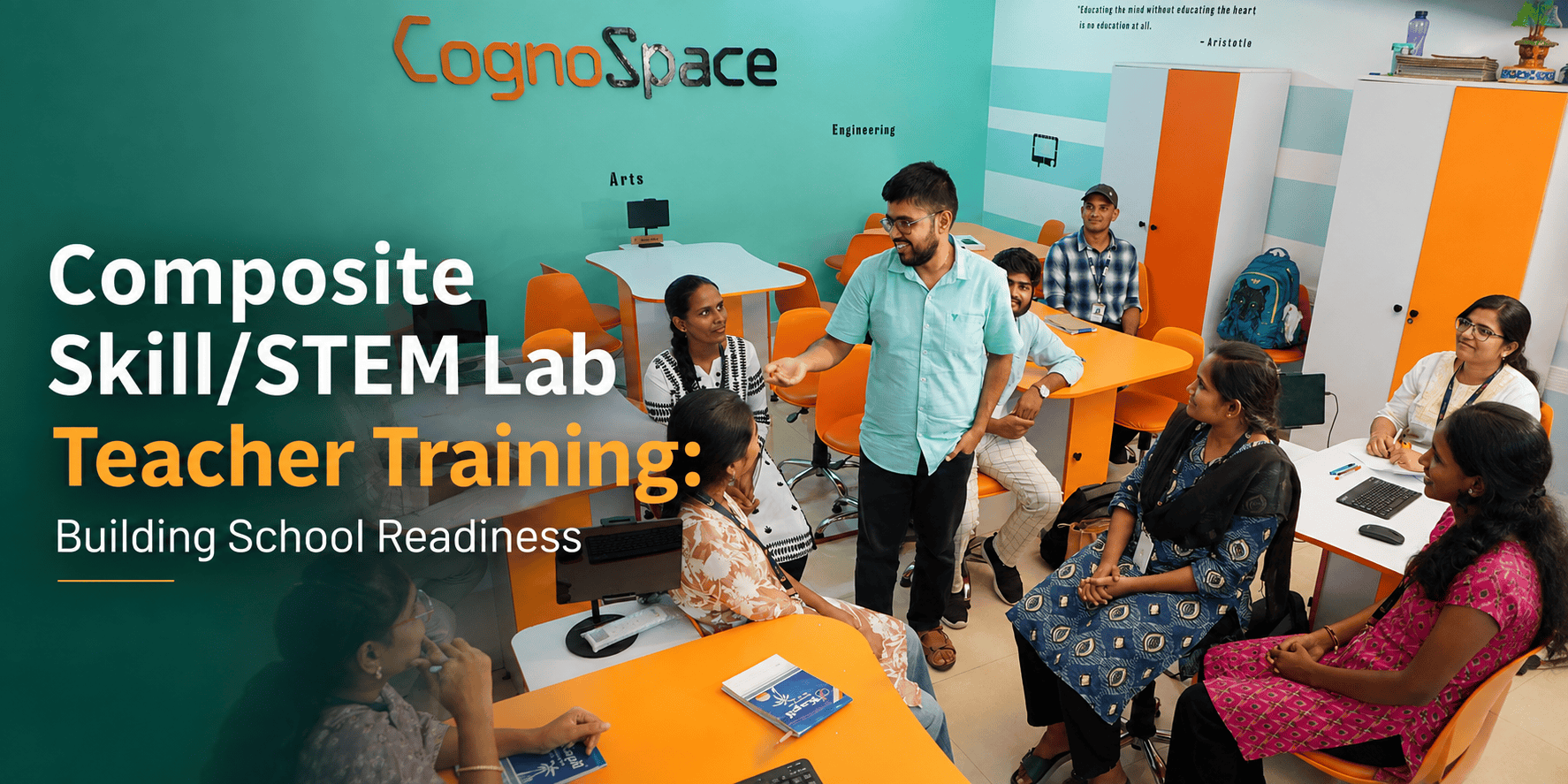


A school can invest in a state-of-the-art Composite Skill Lab, equip it with workstations, STEM resources, robotics and technology, and create a well-designed learning environment.
But there is one important question that often gets overlooked:
Are the teachers ready to use it effectively?
A lab becomes meaningful only when teachers can confidently take students through activities, explain concepts, manage equipment, encourage experimentation and connect practical work with classroom learning.
This is why Composite Skill/STEM Lab teacher training is an important part of successful school implementation.
At CognoSpace, we look at teacher readiness as more than a one-day orientation. The focus is on helping educators understand the lab, practise activities, prepare for sessions and deliver hands-on learning effectively throughout the academic year.
Why Teacher Training Matters in a Composite Skill/STEM Lab
Imagine a school has a fully equipped lab with robotics kits, electronics, models, workstations and digital learning resources.
The equipment is ready.
The room is ready.
The timetable is ready.
But when students enter the lab, the teacher is unsure about how to conduct the activity.
This is where the implementation can slow down.
A successful Composite Skill Lab needs teachers who are comfortable with practical learning.
They should know:
- What activity is planned
- What students are expected to learn
- Which resources are required
- How to introduce the concept
- How students should work in teams
- How to guide students without giving them every answer
- How to manage the equipment
- How to assess the activity
- How to document observations and feedback
This is the foundation of Composite Skill Lab/STEM readiness.
What Is Composite Skill/STEM Lab Teacher Training?
Composite Skill Lab teacher training is the process of preparing educators to confidently conduct practical, activity-based and interdisciplinary learning sessions inside the lab.
It is not limited to explaining how a particular kit works.
Teachers need to understand the complete learning process.
At CognoSpace, educator orientation includes understanding the organisation, activity-based curriculum, comprehensive STEAM lab approach, delivery and support, as well as the role of the STEM educator.
The training then moves into practical aspects of conducting sessions.
This makes Composite Skill Lab training for teachers more closely connected to actual school implementation.
From Lab Infrastructure to Classroom Execution
Infrastructure is important.
But infrastructure alone does not guarantee learning.
A school may have excellent equipment, but teachers need the confidence to turn that equipment into meaningful Composite/STEM Skill Lab activities.
For example, students may be building a pulley, exploring electric circuits or working on a robotics project.
The teacher's role is not simply to distribute the materials.
The teacher needs to:
- Introduce the topic.
- Explain the objective.
- Organise students into teams.
- Ensure the required resources are available.
- Guide students through the activity.
- Encourage questions.
- Help students troubleshoot.
- Conduct assessment.
- Ensure the workstations are restored.
- Record observations and feedback.
That is what turns teacher training for skill education into practical preparation.
What Does Composite Skill Lab Training for Teachers Cover?
A useful Composite Skill/STEM Lab training for teachers should cover both pedagogy and practical execution.
1. Understanding the Lab
Teachers first need to understand what the lab is designed to achieve.
They should become familiar with:
- Workstations
- Tools and materials
- STEM kits
- Digital resources
- Equipment
- Storage
- Safety practices
- Lab workflow
A physical walkthrough is important so teachers can understand the lab and its different elements.
2. Understanding the Curriculum
Teachers should know what students are going to learn and how activities progress across grades.
The Composite Skill Lab curriculum should not feel disconnected from the classroom.
It should help students apply concepts through practical experiences.
The curriculum can include conceptual Science and Mathematics activities as well as Robotics & Engineering domains such as Structural Engineering, Mechanics, Renewable Energy, Kinematics, Hydraulics, Mechatronics, Electrical Science and IoT/Automation.
3. Learning the Activities
Teachers should practise activities themselves before conducting them with students.
This is one of the most important parts of hands-on teacher training.
When teachers perform an activity themselves, they understand:
- How the activity works
- Where students may face difficulties
- Which materials are required
- How much time it takes
- What common mistakes may occur
- How to explain the concept more clearly
Preparing Teachers for STEM, Robotics and Technology Activities
A modern CBSE Composite Skill Lab may bring several disciplines together.
Teachers therefore need exposure to different types of practical learning.
Science and Mathematics
Teachers can be trained around activities such as:
- Making a pulley
- Capillary action
- Kaleidoscope DIY
- Profit and loss
- Area and perimeter
- Testing for nutrients
- Fractions
- Types of motion
- Hot air
- Electric circuits
These activities help teachers understand how academic concepts can be experienced through practical work.
Robotics and Engineering
Teachers can also develop practical confidence in areas such as:
- Mechanics
- Structural Engineering
- Kinematics
- Hydraulics
- Electrical Science
- Mechatronics
- Robotics
- IoT and Automation
For example, teachers can work with projects such as robotic arms, human-following robots, obstacle-avoiding robots, Bluetooth-controlled robots and automation projects.
IoT and Automation
Teachers can introduce students to sensors, actuators, controllers and programming through practical projects.
Activities can include automatic streetlights, sensor integration, weather monitoring and home monitoring systems.
Data Science and AI
Teacher training for CBSE schools also needs to consider emerging areas such as AI and data.
Teachers can be introduced to:
- Data collection
- Data organisation
- Data visualisation
- Algorithms
- Introduction to AI
- Machine learning concepts
- AI applications
- AI ethics
- Structured and unstructured data
Experiential Learning Starts With the Teacher
Students learn differently when they are allowed to explore instead of simply receiving information.
That is the idea behind experiential learning for teachers as well.
Teachers should experience the learning process themselves.
They should build something.
They should test something.
They should make mistakes.
They should troubleshoot.
Then they can better understand what students experience during a practical session.
This changes the teacher's role from simply delivering information to becoming a facilitator of learning.
Teacher Readiness for Skill Labs Is Also About Planning
One of the biggest differences between a successful lab programme and an inconsistent one is preparation.
Teachers should not enter the lab and decide what to do at the last minute.
Before a session, they need to know:
- Which class is attending
- Which topic is planned
- Which kits are required
- Which consumables are needed
- What digital content is required
- How students will be grouped
- How much time is available
- What assessment will be conducted
This kind of preparation directly supports teacher readiness for skill labs.
Teacher Training Continues Beyond the First Workshop
One of the challenges with conventional training is that a teacher may attend a workshop, feel confident for a few days and then encounter practical problems once regular classes begin.
That is why CSL teacher training should ideally include continued implementation support.
This support can include weekly delivery planning and activity instructions so educators know what is coming in the following week and have time to practise the required TLMs and activities.
Educators can also receive regular touch-base support covering:
- Sessions already conducted
- Observations
- Upcoming topics
- Challenges
- School feedback
This makes skill lab training for teachers an ongoing process rather than a one-time event.
Supporting Teachers With Curriculum and Activity Resources
Teachers should not have to create every activity from scratch.
A structured Composite Skill Lab curriculum can provide clarity about:
- What to teach
- When to teach it
- Which activity to conduct
- What resources are required
- What students should observe
- What students should learn
Weekly delivery plans along with activity instructions can give educators time to prepare before the session.
This reduces last-minute preparation and allows teachers to focus more on students.
Lab Management Is Part of Teacher Training Too
Teaching inside a Composite Skill Lab also involves operational responsibilities.
Teachers need to know how to:
- Manage workstations
- Maintain inventory
- Handle kits
- Organise consumables
- Check equipment
- Record attendance
- Record feedback
- Maintain schedules
- Keep the lab organised
Good lab management is an important part of smooth and consistent implementation.
So, Composite Skill Lab implementation is not just an academic responsibility. It also requires good day-to-day lab management.
Feedback Helps Improve Composite Skill/STEM Lab Implementation
A teacher may notice something that is not visible from a curriculum document.
Perhaps students are struggling with a particular step.
Perhaps an activity takes longer than expected.
Perhaps students are highly engaged with one topic but need more guidance with another.
This feedback is valuable.
Teachers can document student engagement, understanding and specific instructions that may be required.
This creates a feedback loop:
Plan → Conduct → Observe → Record → Review → Improve
That is an important part of sustainable Composite Skill Lab implementation support.
Why Continuous Support Makes a Difference
A school should not have to figure everything out after the lab is installed.
The transition should be supported.
That means teachers should have access to:
- Activity instructions
- Curriculum plans
- Resource information
- Scheduling support
- Inventory systems
- Feedback mechanisms
- Technical guidance
- Regular communication
This is especially useful when a school is implementing a CBSE Composite Skill Lab across multiple grades.
The objective is to make teachers feel that they have a support system behind them—not that they are expected to manage everything alone.
CognoSpace: Infrastructure Plus Teacher Training
At CognoSpace, we believe a successful Composite Skill Lab needs more than state-of-the-art infrastructure.
It needs people who know how to use that infrastructure effectively.
That is why our approach brings together:
Infrastructure + Curriculum + Activities + Teacher Training + Implementation Support
The educator training programme begins with orientation and the role of the STEM educator, moves into curriculum and lab familiarisation, and then focuses on session planning, activity execution and practical delivery.
Teachers are also prepared to work with practical areas such as Science, Mathematics, Robotics & Engineering, Mechatronics, IoT/Automation, AI, Tinkering and technology-based activities.
This helps schools move from simply having a lab to actually using the lab consistently.
What Makes a School Composite Skill/STEM Lab Ready?
A school can consider itself more prepared when the following pieces are in place:
- Infrastructure is ready
The physical lab, workstations, equipment and storage are organised. - Curriculum is ready
Teachers know what activities are planned and how they connect to learning outcomes. - Teachers are ready
Educators have practised the activities and understand the session flow. - Resources are ready
Required kits, consumables and digital resources are available. - Timetables are ready
Regular sessions are planned rather than occasional demonstrations. - Support is ready
Teachers know where to seek help when they encounter challenges. - Feedback is active
The school regularly reviews student engagement and programme delivery.
Together, these elements create genuine Composite Skill Lab readiness.
The Goal Is Not to Train Teachers to Operate Equipment
This distinction matters.
Composite Skill Lab teacher training should not be reduced to:
“This is a robot. This is how you switch it on.”
The deeper purpose is:
“How can this robot help students understand a concept, solve a problem and develop a skill?”
The same applies to circuits, sensors, AI, 3D printing, engineering models and other resources.
Teachers need the confidence to ask students questions, encourage them to test ideas and guide them when something doesn't work.
That is what makes teacher training for skill education meaningful.
Conclusion
A Composite Skill Lab can give schools a powerful environment for hands-on and interdisciplinary learning.
But the success of the lab ultimately depends on what happens inside it every week.
- Are students regularly conducting activities?
- Are teachers confident?
- Are resources available?
- Are sessions planned?
- Are challenges being addressed?
- Is student feedback being used?
These questions are at the heart of successful Composite Skill Labs.
For schools, investing in Composite Skill Lab training for teachers is therefore not an additional step after setting up the lab. It is part of the implementation itself.
With hands-on teacher training, structured Composite Skill Lab activities, a clear Composite Skill Lab curriculum, ongoing support and practical implementation systems, teachers can become confident facilitators of experiential learning.
At CognoSpace, our approach combines state-of-the-art infrastructure with teacher training and ongoing implementation support, helping schools create a more consistent and sustainable skill-learning environment.
Because a lab is only as effective as the learning that happens inside it.
And that learning begins with a teacher who is ready.
Frequently Asked Questions
1. Why is teacher training important for a Composite Skill Lab?
Teacher training helps educators understand the curriculum, practise activities, use lab resources confidently, manage sessions and guide students through hands-on learning.
2. What does Composite Skill Lab teacher training include?
It can include lab orientation, curriculum familiarisation, activity practice, session planning, classroom management, assessment, documentation, inventory management and ongoing implementation support.
3. Is one teacher training session enough for a Composite Skill Lab?
A one-time orientation can introduce the lab, but continued support, activity preparation, practice and feedback can make implementation more consistent.
4. What areas can teachers learn during CSL training?
Depending on the curriculum, training can cover Science, Mathematics, Robotics & Engineering, Mechatronics, Electrical Science, IoT/Automation, AI, Tinkering and other practical learning areas.
5. How does CognoSpace support teachers after training?
CognoSpace's implementation process includes weekly activity planning, activity instructions, scheduling and feedback systems, inventory management and regular educator touch-base support.
6. Who is Composite Skill Lab teacher training meant for?
It is particularly useful for teachers and educators responsible for conducting practical, STEM, skill-based and experiential learning sessions in schools.