
How to Set Up a Composite Skill
Lab: A Guide for CBSE Schools | CognoSpace
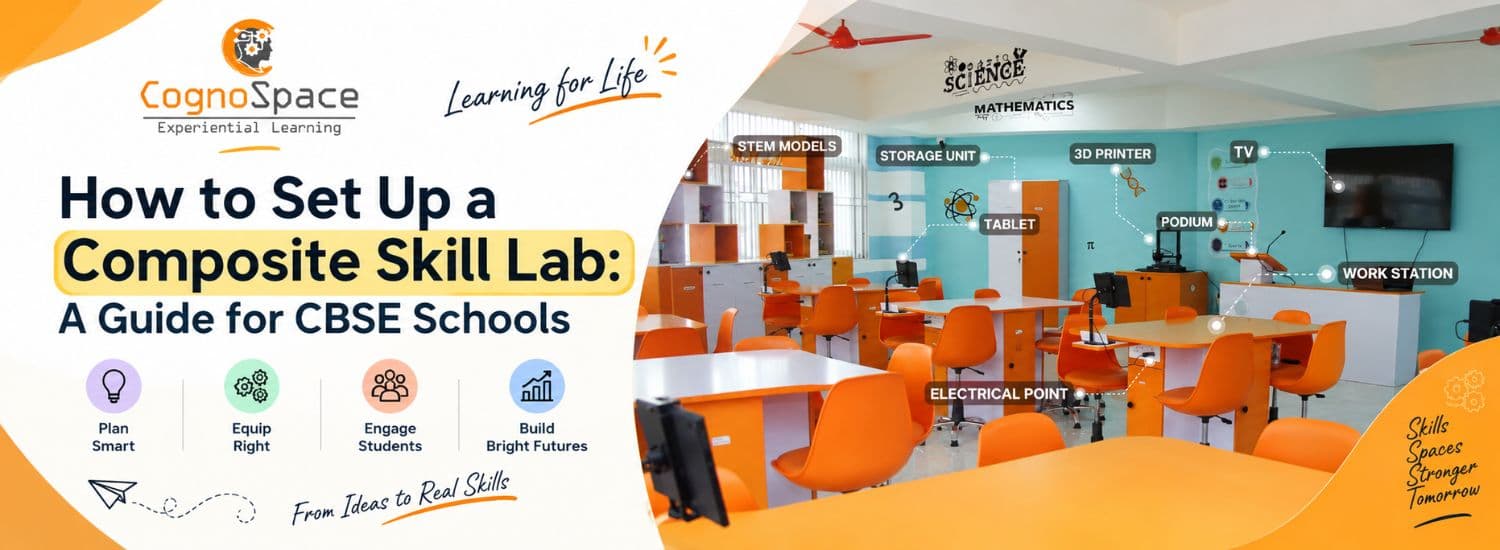


Composite skill lab setups are becoming an important part of modern school education as schools look for practical ways to connect classroom concepts with real-world learning. Instead of limiting students to textbooks and lectures, a well-planned lab gives them opportunities to build, experiment, test ideas, solve problems and learn from mistakes.
For CBSE schools, planning a composite skill lab setup should go beyond purchasing equipment. The space needs a structured curriculum, appropriate infrastructure, hands-on activities, digital learning resources, teacher training, assessment and regular maintenance. CognoSpace brings these elements together through its Composite Skill and STEM Lab model.
The CognoSpace provides 500+ cutting-edge tools, 650+ hands-on activities for Grades III–IX, 30+ modules covering STEM and life skills, faculty training, LMS-based digital content, dedicated relationship management and complete lab maintenance.
For a school planning a composite skill lab for schools, the important question is not simply, “What equipment should we install?” It is, “What should students be able to create, understand and solve after using the lab?”
What is a Composite Skill Lab?
A composite skill lab is a multidisciplinary learning environment where students develop practical, technical, creative and problem-solving skills through hands-on experiences.
A composite skill lab CBSE program can bring together areas such as science, mathematics, robotics, engineering, artificial intelligence, coding, design thinking, financial literacy, computational thinking and life skills.
The CognoSpace curriculum is designed for Grades III–IX and includes four broad areas: Conceptual Learning, Robotics & Engineering, Technology & AI, and Arts & Life Skills. It includes topics such as mechatronics, kinematics, mechanics, IoT, drones, AI, 3D printing, app development, financial literacy and design thinking.
This makes the composite skill lab more than a traditional laboratory. Students are encouraged to move from understanding a concept to applying it.
Why Do Schools Need a Composite Skill Lab?
A modern composite skill lab for schools can help students develop abilities that are difficult to build through theoretical learning alone.
When students construct a mechanism, work with a robotics kit, test an electrical concept or create a design, they have to think about what they are doing. They may make mistakes, change their approach and try again.
That process naturally encourages curiosity, logical thinking, creativity and problem-solving.
CognoSpace describes its learning model as multidisciplinary and experiential, with hands-on activities designed around STEM, engineering, technology, AI and life skills.
For schools considering a composite skill lab setup, this approach can make practical learning a regular part of the timetable rather than an occasional activity.
Step 1: Start With the Curriculum
The first step in a composite skill lab setup for schools is to understand what students should learn.
The lab should not be designed around equipment alone. Activities should have clear learning objectives and should be suitable for the students' grade levels.
CognoSpace offers 650+ hands-on activities across 30+ modules for Grades III–IX. The curriculum combines conceptual learning, robotics and engineering, technology and AI, and arts and life skills.
This curriculum-first approach helps a skill lab for schools become an extension of learning rather than a separate room that students rarely use.
Step 2: Plan the Infrastructure
A practical composite skill lab needs infrastructure that supports both individual and collaborative work.
CognoSpace's lab setup includes workstations, a presentation platform, storage units, STEM models, tablets, electrical points, cabinets and a 3D printer. The lab also includes robotics and engineering kits, science and mathematics concept kits, books or lab manuals and an LMS.
Good planning is important because students need space to assemble projects, use resources, discuss ideas and present their work.
A school can also consider how its STEM lab for schools requirements can be integrated into the wider skill-learning environment.
Step 3: Choose Equipment for Learning, Not Display
When selecting skill lab equipment for schools, schools should focus on usefulness rather than simply choosing equipment that looks advanced.
The right equipment should allow students to perform meaningful activities.
For example, robotics and engineering kits can support mechanical and engineering concepts. STEM models can help students visualise ideas. 3D printing can introduce students to prototyping and design. Tablets can support digital content and activity instructions.
CognoSpace's infrastructure combines these resources into one experiential learning environment.
This makes skill lab equipment more useful when every resource is connected to a planned activity.
Step 4: Create a Structured Learning Session
A composite skill lab setup for schools should have a clear session flow.
CognoSpace follows a 45-minute lab-session structure involving visual learning, experiential learning, reflection, evaluation and post-session or at-home learning. Students can use videos, activity resources, instructions and manuals during the process.
This is important because students should know what they are learning before they start building.
A typical session can move from:
Understand → Build → Experience → Reflect → Evaluate
This makes the composite skill lab CBSE experience more organised and easier for teachers to implement.
Step 5: Train Teachers
Infrastructure alone does not make a successful lab.
Teachers need confidence to conduct practical activities, guide students and encourage them to find solutions independently.
CognoSpace provides faculty training or the option of deploying a trained educator. The program also includes a dedicated Relationship Manager and ongoing delivery support.
For any skill lab setup for schools, teacher support should therefore be considered an essential part of implementation.
A teacher's role is not always to give students the answer. Sometimes the better approach is to ask, “Why did this happen?” or “What could you change?”
That simple shift can make practical learning much more engaging.
Step 6: Use Digital Learning Alongside Hands-On Activities
A STEM lab setup becomes stronger when physical activities are supported by digital resources.
CognoSpace provides an LMS and digital content to support session execution. Its lab model also includes tablets at workstations, while students can access learning resources at home for revision and preparation.
This combination allows students to see a concept, work with it physically and then revisit the learning material later.
It also makes an innovation lab for schools more structured because students can use digital resources while developing and testing their ideas.
Step 7: Include Assessment and Progress Tracking
A good composite skill lab for schools should not stop when the activity ends.
Students should have opportunities to reflect on what they learned and demonstrate their understanding.
CognoSpace includes assessments for activities, learning profiles, progress dashboards, mid-year assessments and end-of-year assessments. It also supports parent-teacher meetings.
This gives schools a way to understand whether students are developing conceptual clarity, problem-solving abilities and other practical skills.
Step 8: Plan Maintenance From the Beginning
One area schools should not overlook while planning a composite skill lab is maintenance.
Equipment gets used regularly. Consumables need replenishment, kits may require replacement and infrastructure may occasionally need repair.
CognoSpace includes complete lab maintenance, including repair and replacement of infrastructure, gadgets and kits, as well as stocking and restocking consumables according to requirements.
This is especially important when selecting school lab equipment because long-term usability matters as much as initial installation.
Step 9: Give Students Opportunities to Showcase Their Work
Students become more motivated when they can demonstrate what they have created.
CognoSpace conducts STEM competitions and supports schools participating in external competitions. It also provides yearly Innovation and Skill Development Certificates.
A robotics lab for schools or broader skill-learning environment can therefore become a platform for students to develop projects, collaborate with classmates and build confidence.
What Makes CognoSpace Different?
CognoSpace approaches a composite skill lab CBSE solution as a complete experiential learning program rather than simply an infrastructure installation.
Its model combines lab infrastructure, curriculum, digital content, maintenance, faculty training and 21st-century skills. Depending on the selected offering, schools can also receive in-person visits, weekly delivery planning, optional books, a dedicated Relationship Manager, design-thinking modules and summer-camp support.
For schools, this integrated approach can make the composite skill lab setup easier to manage throughout the academic year.
Composite Skill Lab vs STEM Lab
A STEM lab for schools generally focuses on science, technology, engineering and mathematics. A composite model can extend beyond these areas to include AI, coding, life skills, financial literacy, design thinking and other practical skills.
This means a school does not necessarily need to think of every learning area as a separate facility.
A thoughtfully designed composite skill lab can bring multiple learning experiences into one connected environment.
Final Thoughts
Setting up a composite skill lab for schools is ultimately about creating better learning experiences.
The strongest model combines:
Infrastructure + Curriculum + Hands-On Activities + Digital Content + Teacher Training + Assessment + Maintenance + Support
For CBSE schools, the right composite skill lab setup for schools should give students regular opportunities to see, touch, build, experiment, troubleshoot and explain what they have created.
CognoSpace brings these elements together through its Composite Skill and STEM Lab program, with 500+ cutting-edge tools, 650+ hands-on activities, 30+ modules, robotics and engineering, AI and technology, digital learning, teacher support and complete maintenance.
The real success of a composite skill lab is not measured by how impressive the room looks on inauguration day. It is measured by what happens after that.
- Do students use the equipment?
- Do they ask questions?
- Do they build things?
- Do they make mistakes and try again?
- Can they explain their ideas?
- Can they work with others?
If the answer is yes, the lab is doing what it was designed to do.
For schools looking to develop practical, future-ready learning environments, a well-planned composite skill lab CBSE solution can become a meaningful part of the student learning journey.
CognoSpace, Igniting Curiosity, Nurturing Creativity.
Frequently Asked Questions (FAQs)
1. What is a Composite Skill Lab?
A Composite Skill Lab is a hands-on learning space where students learn by building, experimenting, testing ideas and solving problems. It can bring together areas such as STEM, robotics, engineering, AI, coding and life skills.
2. Why should CBSE schools set up a Composite Skill Lab?
A Composite Skill Lab gives students opportunities to apply what they learn in the classroom. It helps them develop practical skills such as problem-solving, creativity, logical thinking, teamwork and learning through experimentation.
3. How do you set up a Composite Skill Lab in a CBSE school?
Schools need to consider the lab space, infrastructure, curriculum, equipment, activities, teacher training, digital resources, assessment and maintenance. Planning these elements together helps create a lab that students can use regularly rather than just as a display facility.
4. What equipment is required for a Composite Skill Lab?
Depending on the curriculum and grade levels, a lab can include robotics and engineering kits, science and mathematics kits, STEM models, tablets, 3D printers, workstations, storage units and digital learning resources. Equipment should be selected based on the activities students will actually perform.
5. How does CognoSpace help schools set up a Composite Skill Lab?
CognoSpace provides an integrated approach that combines lab infrastructure, curriculum, hands-on activities, digital content, teacher training, assessment and maintenance. Its program includes 500+ tools, 650+ hands-on activities and 30+ modules for Grades III–IX, helping schools implement practical learning throughout the academic year.