
Kaushal Bodh: A Complete Guide to
Activities, Projects and Skill Development for Schools


Education becomes more meaningful when students get an opportunity to do something with what they learn. Reading about a concept is useful, but building something, working with materials, solving a problem, or understanding how a service works can create a much deeper learning experience.
This is the idea behind Kaushal Bodh.
The Kaushal Bodh Program focuses on practical, project-based and vocational learning, giving students opportunities to develop skills through activities connected to real-life situations and the world of work.
For schools, this approach can make skill development more practical and engaging. Students can learn to plan, create, communicate, solve problems, work in teams, and understand how their learning connects with everyday life.
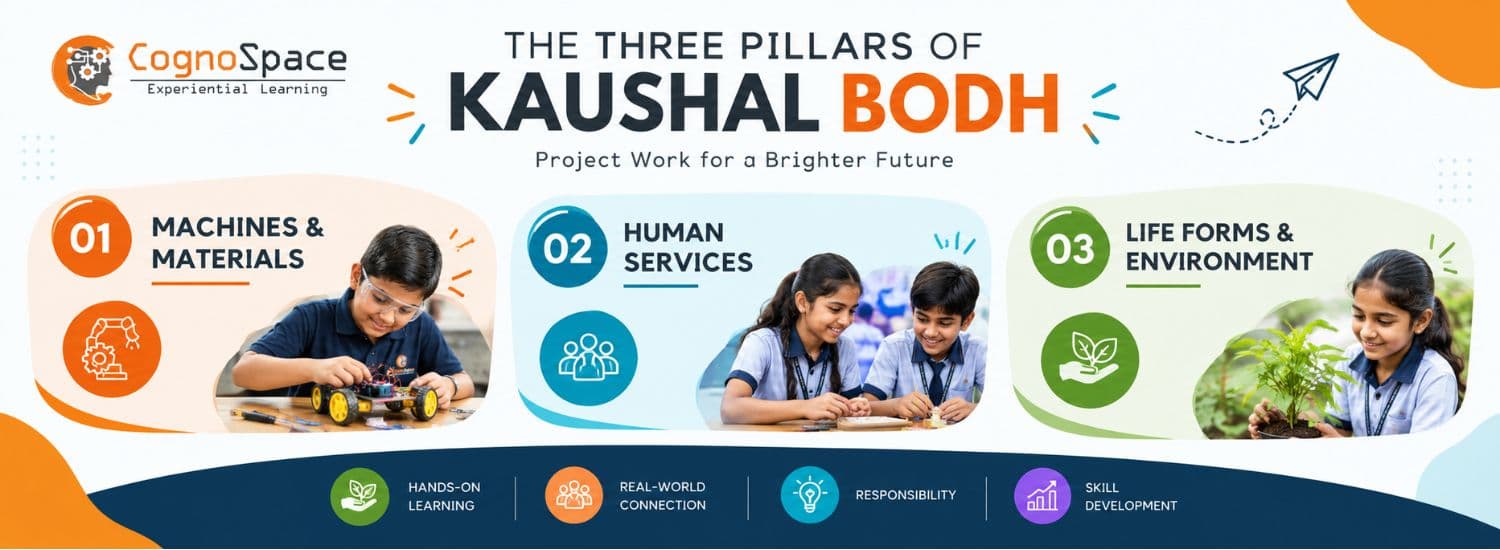
CognoSpace supports this approach through its Kaushal Bodh Project Work module, designed for Grades 6–9 with 26 activities covering machines and materials, human services, and life forms and the environment.
What Is Kaushal Bodh?
Kaushal Bodh is an experiential learning approach that gives students opportunities to develop practical skills through projects and hands-on activities.
Instead of learning only through explanations and written exercises, students participate in activities where they can explore real-world situations and understand how different skills are used.
The focus is on learning through experience.
Students may be encouraged to:
- Plan a project
- Work with materials and tools
- Explore real-life situations
- Build or create something
- Work with others
- Solve practical problems
- Understand different processes
- Reflect on their experiences
- Develop responsible work practices
This makes Kaushal Bodh experiential learning particularly useful for helping students connect classroom knowledge with practical situations.
Why Is the Kaushal Bodh Program Important for Schools?
Schools are not only preparing students for examinations. They are also helping students develop the skills they will need in everyday life and future workplaces.
A student who completes a practical project has to make decisions. They may need to decide what materials to use, how to organise their work, how to solve an unexpected problem, or how to improve their final result.
These experiences can help students develop confidence and practical thinking.
The Kaushal Bodh Program creates opportunities for students to explore different areas of work and understand that learning can happen through making, doing, observing and solving problems.
For schools, this can also support a broader approach to Kaushal Bodh skill development, where practical abilities are developed alongside academic learning.
Kaushal Bodh Activities for Students
The success of Kaushal Bodh activities for students depends on giving them meaningful opportunities to participate rather than simply asking them to follow instructions.
A good activity can start with a simple question or real-world situation.
For example:
What problem are we trying to solve?
Students can then discuss the problem, plan their approach, work with materials, test their ideas and think about what they could improve.
This process helps students understand that mistakes are a normal part of learning.
Through Kaushal Bodh activities, students can develop skills such as:
- Planning
- Problem-solving
- Teamwork
- Communication
- Creativity
- Decision-making
- Practical thinking
- Responsibility
- Observation
- Resource management
The focus is therefore not just on completing an activity but on what students learn while carrying it out.
Kaushal Bodh Projects and Project Ideas
Projects give students more time to explore a problem and develop a solution.
Some practical Kaushal Bodh project ideas can include activities related to the environment, machines, materials, community services and everyday work.
For example, students could work on:
Waste Management Projects
Students can explore how waste is generated, how it can be separated, and how responsible waste management can be encouraged within their surroundings.
Environment-Based Projects
Students can observe their local environment and explore ways to protect natural resources and encourage responsible practices.
Machine and Material Projects
Students can work with materials and simple mechanisms to understand how things are designed, built and improved.
Community-Based Projects
Students can explore different services within their community and understand how people and organisations contribute to society.
The exact activity can be adapted according to the students, available resources and school environment.
Three Key Areas of the CognoSpace Kaushal Bodh Module
CognoSpace has structured its Kaushal Bodh Project Work around three practical areas.
1. Machines & Materials
The Machines & Materials area focuses on creating, building and innovating.
Students get opportunities to work with materials and explore how different objects, mechanisms and systems can be developed.
Rather than simply learning about machines theoretically, students can engage in practical activities that encourage them to think about how something works and how it can be improved.
This can make Kaushal Bodh projects more engaging for students who enjoy building and experimenting.
2. Human Services
The Human Services area introduces students to service-oriented activities and the role of people in building and supporting communities.
Students can explore how different services work and why they are important in everyday life.
Such activities can also encourage communication, teamwork, planning and responsibility.
This helps students understand that vocational learning is not limited to machines or technical work. People-oriented skills and services are equally important.
3. Life Forms & Environment
The Life Forms & Environment area connects practical learning with living systems and the environment.
Students can participate in activities related to nature, plants, environmental awareness and responsible practices.
These experiences can help students understand their surroundings while encouraging them to think about how everyday actions can affect the environment.
Kaushal Bodh Vocational Education Through Practical Learning
Kaushal Bodh vocational education can introduce students to different types of practical work in an age-appropriate way.
The purpose is not simply to teach students about a particular occupation. It is about helping them understand how skills, planning, teamwork, responsibility and problem-solving are used in real situations.
For example, when students work on a project, they may have to:
Understand → Plan → Create → Test → Improve → Reflect
This simple process reflects how many real-world tasks are approached.
Students learn that a solution does not always work perfectly the first time. They may need to make changes, discuss their ideas with others and try again.
That is an important part of Kaushal Bodh experiential learning.
Kaushal Bodh Implementation in Schools
Effective Kaushal Bodh implementation in schools requires more than conducting occasional activities.
Schools need to think about the complete learning experience.
Teachers
Teachers need to understand the purpose of each activity and how to guide students without doing
the work for them.
Learning Resources
Students need access to suitable materials, tools and resources for practical activities.
Learning Space
A suitable environment makes it easier for students to work in groups, create projects and
experiment.
Project Planning
Activities should be planned according to students' grade levels, available time and learning
objectives.
Reflection
Students should have opportunities to discuss what they did, what they learned and what they
could do differently next time.
This makes the implementation of the Kaushal Bodh education program more meaningful and organised.
The Role of Kaushal Bodh Teacher Training
Teachers play an important role in experiential learning.
A practical activity can have very different outcomes depending on how it is introduced and facilitated.
Kaushal Bodh teacher training can help educators become more comfortable with project-based learning, activity facilitation, teamwork and student-led exploration.
Instead of immediately providing answers, teachers can encourage students to ask questions such as:
- What are we trying to achieve?
- What materials do we need?
- Why did this approach work?
- Why did it fail?
- What can we change?
- Can we find another solution?
This changes the teacher's role from simply delivering information to guiding students through the learning process.
How CognoSpace Supports Kaushal Bodh for Schools
For schools, one of the biggest challenges with experiential learning is creating a structured environment where students can regularly participate in practical activities.
This is where CognoSpace can support schools.
CognoSpace's Kaushal Bodh Project Work module is designed for Grades 6–9 and includes 26 activities. The module brings together three areas: Machines & Materials, Human Services, and Life Forms & Environment.
The objective is to give students opportunities to develop practical skills through hands-on projects and vocational activities.
The CognoSpace approach focuses on helping students:
- Develop practical skills through hands-on projects
- Apply knowledge to real-life situations
- Understand workplace-oriented contexts
- Build planning and problem-solving abilities
- Develop teamwork and communication skills
- Understand tools, materials and processes
- Explore different vocational areas
- Develop awareness of the world of work
This makes CognoSpace relevant for schools looking to create a more structured environment for Kaushal Bodh activities and experiential learning.
Kaushal Bodh Learning Outcomes
The value of Kaushal Bodh learning outcomes should not be measured only by whether a student finishes a project.
The more important question is: What did the student learn while doing it?
Through practical activities, students can develop:
- Practical skills
- Problem-solving abilities
- Planning skills
- Communication
- Teamwork
- Creativity
- Decision-making
- Responsible work practices
- Awareness of different types of work
- Confidence in handling practical situations
These skills can support students not only during school but also as they move towards higher education, vocational exploration and future careers.
Why Kaushal Bodh Matters for the Future of School Education
The world students are preparing for is changing quickly. Future learning will require more than the ability to remember information.
Students will need to know how to think, create, collaborate, communicate and solve problems.
This is why practical and experiential approaches such as Kaushal Bodh for CBSE schools can be valuable.
When students are given opportunities to work on real-world projects, they begin to understand that learning is not restricted to a textbook or classroom.
A project about the environment can connect science with responsibility.
A machine-based activity can connect design with engineering.
A human-services activity can connect learning with community and communication.
This makes education more connected to the world students see around them.
Conclusion
Kaushal Bodh brings an important idea into school education: students learn deeply when they get opportunities to experience, create, solve and reflect.
The Kaushal Bodh Program gives schools a framework for developing practical and vocational skills through projects and activities. For students, it can make learning more active and connected to real-life situations.
CognoSpace supports this approach through its Kaushal Bodh Project Work module for Grades 6–9, featuring 26 activities across Machines & Materials, Human Services, and Life Forms & Environment.
The ultimate goal is not simply to complete a project.
It is to help students learn how to plan, build, communicate, solve problems, work responsibly and understand the world around them.
When students learn by doing, even a simple project can become an opportunity to develop skills that stay with them long after the activity is over.
Frequently Asked Questions
1. What is Kaushal Bodh?
Kaushal Bodh is an experiential and project-based learning approach that helps students develop practical, vocational and life skills through hands-on activities. It encourages students to learn by doing, creating, solving problems and reflecting on their experiences.
2. What is the Kaushal Bodh Program?
The Kaushal Bodh Program provides opportunities for students to participate in practical projects and activities connected to real-life situations and the world of work. It focuses on developing skills such as planning, teamwork, communication, problem-solving and responsible work practices.
3. What are Kaushal Bodh activities for students?
Kaushal Bodh activities for students are practical, hands-on tasks that allow learners to explore real-world situations. Activities may involve machines and materials, human services, life forms, environmental topics, problem-solving and community-related projects.
4. What are some Kaushal Bodh project ideas for schools?
Kaushal Bodh project ideas can include waste management projects, environmental activities, machine and material projects, community-based projects and activities related to everyday services. Schools can adapt projects according to students' grade levels, available resources and learning objectives.
5. What skills do students develop through Kaushal Bodh?
Through Kaushal Bodh activities and projects, students can develop planning, problem-solving, creativity, teamwork, communication, decision-making, observation, practical thinking and responsibility. The activities also help students understand different types of work and real-life processes.
6. What are the key areas covered in the CognoSpace Kaushal Bodh Project Work module?
The CognoSpace Kaushal Bodh Project Work module covers three key areas: Machines & Materials, Human Services, and Life Forms & Environment. These areas provide students with opportunities to explore practical work, services, materials, living systems and environmental topics.
7. Which grades are covered by the CognoSpace Kaushal Bodh Project Work module?
The CognoSpace Kaushal Bodh Project Work module is designed for Grades 6–9 and includes 26 activities across Machines & Materials, Human Services, and Life Forms & Environment.
8. How can schools implement Kaushal Bodh effectively?
Effective Kaushal Bodh implementation in schools requires suitable activities, learning resources, teacher guidance, an appropriate practical learning space and proper project planning. Students should also be given opportunities to reflect on what they learned from each activity.
9. Why is Kaushal Bodh teacher training important?
Kaushal Bodh teacher training can help educators understand how to facilitate project-based and experiential learning. Teachers can learn how to guide students, encourage exploration, ask meaningful questions and allow students to find solutions rather than simply providing answers.
10. How does CognoSpace support Kaushal Bodh for schools?
CognoSpace supports Kaushal Bodh for schools through its Kaushal Bodh Project Work module, which provides 26 activities for Grades 6–9. The module covers Machines & Materials, Human Services, and Life Forms & Environment and helps schools provide structured opportunities for practical and vocational learning.