The Future of Education Starts with Kaushal Bodh:
Why Every CBSE School Needs Experiential Learning


For years, education has focused heavily on textbooks, classroom lectures, and examinations. While academic knowledge remains important, today's students need much more than theoretical understanding to succeed in the real world. They need practical skills, critical thinking, creativity, teamwork, and the confidence to solve real-life problems.
Recognizing this need, the Central Board of Secondary Education (CBSE) has introduced Kaushal Bodh as a mandatory vocational education subject for students in Grades 6 to 8, aligned with the National Education Policy (NEP) 2020 and the National Curriculum Framework for School Education (NCF-SE) 2023. The curriculum is designed to provide students with structured exposure to the world of work through meaningful, project-based learning.
But what exactly is Kaushal Bodh, and how can schools successfully implement it? Let's explore.
What is Kaushal Bodh?
Kaushal Bodh is CBSE's vocational education programme for middle school students. Unlike traditional classroom learning, it encourages students to learn by doing.
Instead of simply reading about concepts, students actively participate in projects, experiments, field visits, observations, teamwork, and community interactions. The objective is to develop practical life skills while nurturing curiosity, creativity, communication, collaboration, and problem-solving abilities. The curriculum also emphasizes respect for all forms of work and connects classroom learning with everyday life.
This shift represents a major step toward preparing students not just for examinations, but for life.
Why Did CBSE Introduce Kaushal Bodh?
The National Education Policy 2020 emphasizes experiential learning, vocational exposure, and skill development from an early age.
Kaushal Bodh has been introduced to ensure students:
- Understand the dignity of labour
- Develop practical vocational skills
- Connect classroom knowledge with real-life situations
- Build confidence through project-based learning
- Learn collaboratively
- Develop future-ready competencies
Rather than memorizing information, students experience learning through activities that mirror real-world situations.
The Three Pillars of Kaushal Bodh
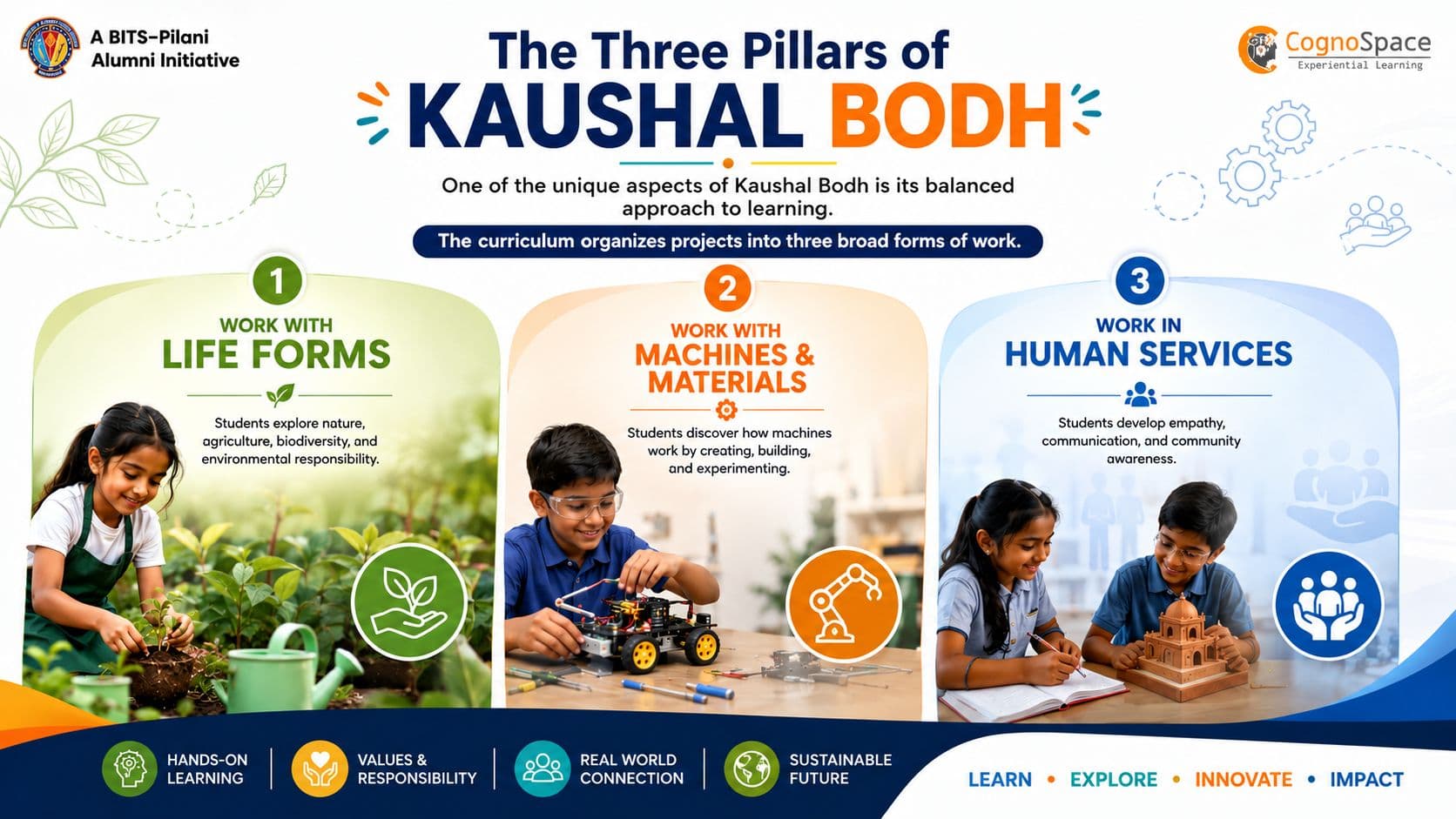
One of the unique aspects of Kaushal Bodh is its balanced approach to learning. The curriculum organizes projects into three broad forms of work:
1. Work with Life Forms
Students explore nature, agriculture, biodiversity, and environmental responsibility through activities such as:
- School Kitchen Gardens
- Biodiversity Registers
- Plant observation
- Composting
- Sustainable practices
2. Work with Machines and Materials
Students discover how machines work by creating, building, and experimenting through projects like:
- Maker Skills
- Simple Machines
- Scratch Programming
- Animation and Games
- Toy Making
- Bicycle Maintenance
3. Work in Human Services
Students develop empathy, communication, and community awareness through activities such as:
- School Museums
- Cooking Without Fire
- Heritage Documentation
- Community Projects
Schools select one project from each category every academic year, giving students exposure to diverse skills and experiences.
Learning Beyond the Classroom
One of the biggest strengths of Kaushal Bodh is that learning doesn't remain inside four classroom walls.
The curriculum encourages:
- Field visits
- Community interaction
- Expert talks
- Hands-on activities
- Practical demonstrations
- Team projects
- Reflection and discussion
Students may visit farms, bicycle repair shops, museums, local markets, biodiversity sites, or interact with artisans, farmers, mechanics, and other community experts. These experiences help students connect theoretical concepts with real-world applications.
Why Hands-On Learning Makes a Difference
Educational research consistently shows that students retain concepts more effectively when they actively participate in the learning process.
Hands-on learning helps students:
- Think critically
- Ask better questions
- Solve problems creatively
- Work collaboratively
- Improve communication
- Build confidence
- Develop leadership skills
Instead of simply learning about science, engineering, technology, or community work, students experience them firsthand. This is exactly the philosophy behind Kaushal Bodh.
Challenges Schools May Face
While the curriculum offers tremendous opportunities, many schools may wonder how to implement it effectively.
Some common challenges include:
- Procuring appropriate learning materials
- Creating dedicated activity spaces
- Planning project-based lessons
- Managing multiple vocational activities
- Providing teachers with practical resources
- Aligning activities with curriculum outcomes
The curriculum itself encourages schools to use locally available materials and community resources while ensuring projects remain age-appropriate, hands-on, and relevant.
How Composite Skill Labs Support Kaushal Bodh
A well-designed Composite Skill Lab can make Kaushal Bodh implementation more structured, engaging, and sustainable.
Rather than arranging separate resources for every activity, schools can create an integrated learning environment where students explore:
- STEM learning
- Maker activities
- Robotics
- Coding
- Artificial Intelligence
- Design Thinking
- Innovation
- Practical science
- Engineering concepts
- Problem-solving challenges
These environments naturally support the experiential, project-based approach encouraged by the Kaushal Bodh curriculum.
How CognoSpace Helps Schools
At CognoSpace, we believe learning should inspire curiosity, creativity, and confidence. Our Composite Skill Labs are designed to help schools create engaging learning environments that align with experiential education goals. They bring together STEM, innovation, coding, robotics, AI, and hands-on learning resources that can complement project-based learning initiatives in schools.
Rather than replacing classroom teaching, these labs enrich it by giving students opportunities to explore, build, experiment, and apply their knowledge in meaningful ways.
Building Future-Ready Students
The careers of tomorrow will require far more than academic excellence.
Students will need to:
- Think independently
- Solve unfamiliar problems
- Collaborate with others
- Adapt to new technologies
- Communicate effectively
- Learn continuously
Kaushal Bodh introduces these capabilities early, helping students become confident learners and responsible citizens.
Final Thoughts
Kaushal Bodh marks an important shift in school education. By moving beyond rote learning and embracing project-based, experiential learning, it prepares students with practical skills, values, and competencies that extend well beyond the classroom.
For schools, successful implementation depends on thoughtful planning, supportive learning environments, and access to appropriate resources. Integrated spaces such as Composite Skill Labs can play a valuable role in helping schools deliver engaging, hands-on learning experiences aligned with the curriculum's objectives.
As education continues to evolve, initiatives like Kaushal Bodh remind us that the best learning happens when students don't just study concepts—they experience them.
Frequently Asked Questions
Is Kaushal Bodh mandatory for CBSE schools?
Yes. The curriculum framework introduces Kaushal Bodh as the vocational education subject for students in Grades 6–8 under the CBSE framework.
What is the objective of Kaushal Bodh?
Its objectives include developing vocational capacities through hands-on learning, connecting classroom learning with real-life situations, and fostering communication, creativity, collaboration, critical thinking, and work-related values.
What are the main Kaushal Bodh projects?
Illustrative projects include School Kitchen Garden, Biodiversity Register, Maker Skills, Animation and Games, School Museum, and Cooking Without Fire.
How can schools implement Kaushal Bodh effectively?
Schools can implement it through structured project planning, hands-on activities, field visits, community participation, and well-equipped experiential learning environments that support practical skill development, consistent with the curriculum guidance.
This structure is optimized for both traditional search engines and AI-driven search by using natural language, question-based headings, topical depth, and clear connections between the curriculum and experiential learning.