Kaushal Bodh: Transforming
Classrooms into Skill-Building Spaces for the Future


Education has always been about preparing students for life. But what students need to succeed today is very different from what was expected a decade ago. Along with academic excellence, they need creativity, critical thinking, collaboration, communication, digital literacy, and practical problem-solving skills.
Recognizing this changing landscape, the Central Board of Secondary Education (CBSE) has introduced Kaushal Bodh, a vocational education programme for students in Grades 6 to 8. Developed in alignment with the National Education Policy (NEP) 2020 and the National Curriculum Framework for School Education (NCF-SE) 2023, Kaushal Bodh gives students their first structured exposure to the world of work through project-based, experiential learning.
This marks an important shift in education—from learning for examinations to learning for life.
Instead of simply reading concepts in textbooks, students are encouraged to build, create, observe, experiment, collaborate, and reflect. This practical approach not only strengthens academic understanding but also develops the confidence and skills students need for the future.
What is Kaushal Bodh and Why is it Important for CBSE Schools?
Kaushal Bodh is much more than another school subject. It is a structured vocational education programme that introduces middle school students to meaningful work experiences through hands-on projects and real-world activities.
The curriculum is designed to help students:
- Appreciate the dignity of labour
- Develop foundational vocational skills
- Connect classroom learning with everyday life
- Build communication and collaboration skills
- Encourage creativity and critical thinking
- Develop responsibility, persistence, curiosity, and empathy
Rather than focusing only on theoretical knowledge, Kaushal Bodh enables students to experience learning through meaningful activities that build practical understanding and lifelong competencies.
For schools, this represents an opportunity to create classrooms where learning becomes more engaging, interactive, and relevant.
How Kaushal Bodh Moves Learning Beyond Memorization
Think about how children traditionally learn about simple machines.
They read definitions, study diagrams, memorize concepts, and answer examination questions.
Now imagine another classroom.
Students build a working model of a windmill, construct a rubber band-powered car, explore how levers work, and identify simple machines in their surroundings.
Which learning experience is likely to stay with them longer?
The answer is obvious.
Kaushal Bodh embraces the philosophy of learning by doing. Instead of treating students as passive learners, it encourages them to become creators, explorers, and problem-solvers.
This shift transforms classrooms into spaces where curiosity drives learning and mistakes become opportunities for discovery.
How the Kaushal Bodh Curriculum Connects Learning with Real Life
One of the most exciting aspects of Kaushal Bodh is that it connects school education with everyday experiences.
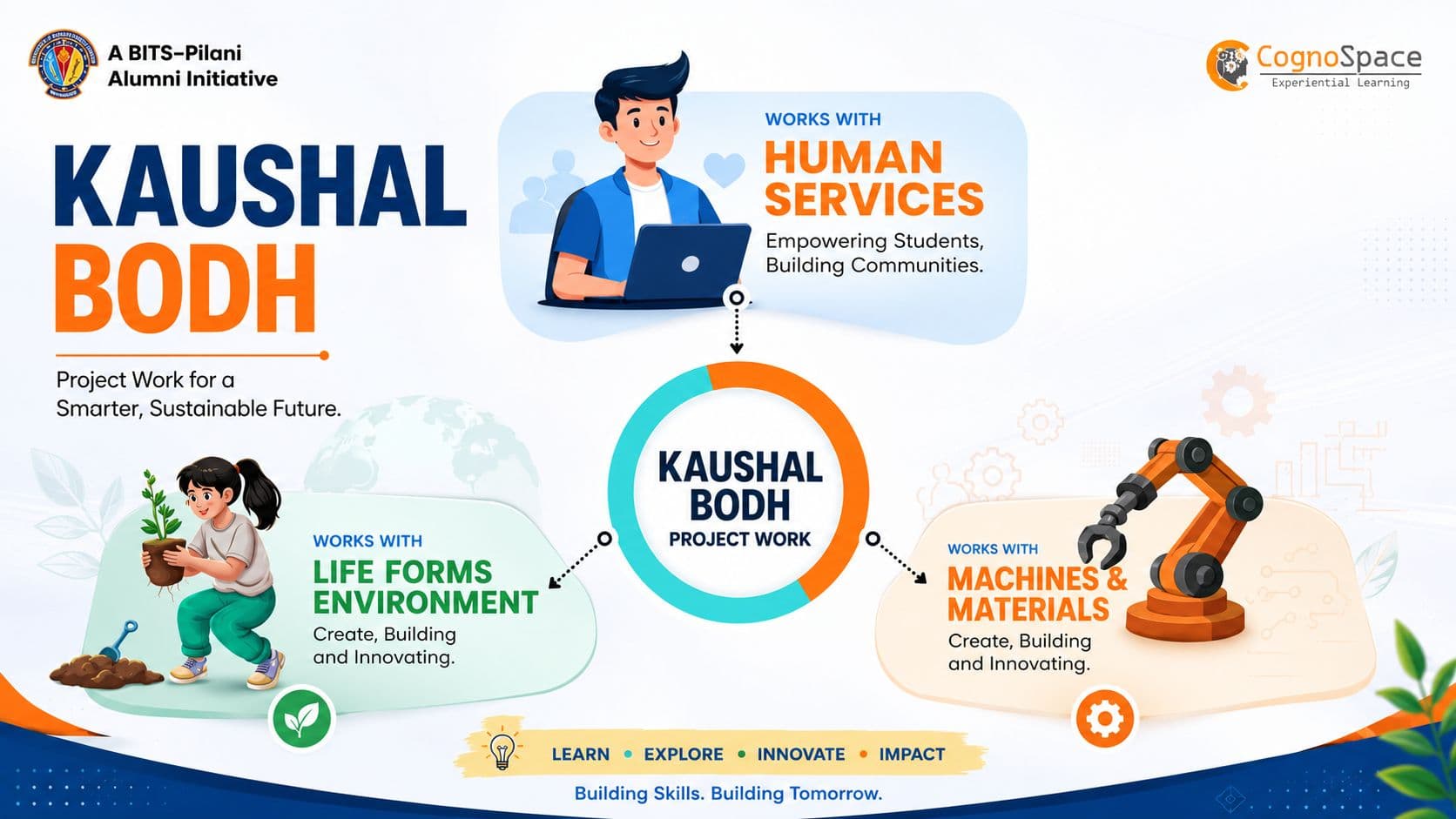
The curriculum is organized into three broad forms of work.
Work with Life Forms
Students develop environmental awareness through activities such as:
- School Kitchen Gardens
- Biodiversity Registers
- Composting
- Plant care
- Sustainable practices
They don't simply study nature—they work with it.
Work with Machines and Materials
Students explore engineering and technology through activities like:
- Maker Skills
- Simple Machines
- Scratch Programming
- Animation and Games
- Toy Making
- Bicycle Maintenance
These projects encourage students to understand how things work by creating and experimenting themselves.
Work in Human Services
Students also develop empathy, teamwork, and community awareness through activities including:
- School Museums
- Cooking Without Fire
- Heritage Documentation
- Community-based projects
Together, these three areas ensure that learning extends beyond classroom walls and into the real world.
How Kaushal Bodh Builds Future-Ready Skills
The world our students will enter after school is changing rapidly.
Many future careers don't even exist today.
This is why Kaushal Bodh focuses on developing transferable skills that remain valuable regardless of career choice.
Students naturally build:
- Communication skills
- Collaboration
- Critical thinking
- Creativity
- Problem-solving
- Leadership
- Responsibility
- Time management
- Adaptability
These competencies are developed while students work together, solve challenges, complete projects, and reflect on their experiences.
Rather than teaching these skills separately, Kaushal Bodh integrates them into meaningful learning activities.
Why Kaushal Bodh Encourages Experiential Learning
Ask any teacher which lessons students remember the longest.
The answer is usually the lessons where students actively participated.
Children remember the seed they planted.
They remember the model they built.
They remember the museum they curated.
They remember the game they programmed.
They remember the exhibition they organized.
Kaushal Bodh recognizes that learning becomes meaningful when students are directly involved.
Some of the curriculum's illustrative projects include:
- School Kitchen Garden
- Biodiversity Register
- Maker Skills
- Animation and Games
- School Museum
- Cooking Without Fire
Each project encourages observation, creativity, teamwork, and practical application while making learning enjoyable and memorable.
Implementing Kaushal Bodh Successfully in Schools
Introducing Kaushal Bodh is an exciting opportunity, but effective implementation requires thoughtful planning.
Schools need to create environments where students can actively participate rather than simply observe.
Successful implementation involves:
- Practical learning spaces
- Appropriate tools and materials
- Teacher facilitation
- Curriculum-aligned projects
- Community participation
- Field visits
- Reflection and assessment
The curriculum also encourages schools to collaborate with farmers, artisans, mechanics, museum professionals, and other community resource persons, making learning richer and more authentic.
How Composite Skill Labs Support Kaushal Bodh Implementation
One of the most effective ways for schools to implement Kaushal Bodh is by creating dedicated experiential learning spaces.
A Composite Skill Lab provides an integrated environment where students can explore multiple disciplines through hands-on activities.
Instead of learning concepts separately, students experience the connection between:
- Science
- Technology
- Engineering
- Mathematics
- Robotics
- Coding
- Artificial Intelligence
- Design Thinking
- Innovation
- Maker Activities
These interdisciplinary experiences closely align with the project-based philosophy of Kaushal Bodh.
Students don't just complete activities—they develop confidence, creativity, and practical skills while solving real-world challenges.
How CognoSpace Helps Schools Implement Kaushal Bodh
At CognoSpace, we believe education should inspire students to think, create, and innovate.
Our Composite Skill Labs are designed to help schools create engaging, future-ready learning environments that support experiential learning and interdisciplinary exploration.
By bringing together STEM education, robotics, coding, artificial intelligence, innovation, and maker activities, CognoSpace enables schools to deliver practical learning experiences that complement the objectives of Kaushal Bodh.
Rather than replacing classroom teaching, our solutions enhance it by giving students opportunities to apply what they learn through meaningful projects and collaborative activities.
For schools looking to strengthen their implementation of Kaushal Bodh, integrated learning environments can become valuable spaces where ideas come to life.
Why Kaushal Bodh is Preparing Students for Tomorrow
The future belongs to learners who can adapt, innovate, collaborate, and solve problems.
Academic excellence remains important, but success increasingly depends on how effectively students can apply their knowledge.
Kaushal Bodh prepares students to become:
- Curious learners
- Independent thinkers
- Creative innovators
- Responsible citizens
- Effective communicators
- Collaborative team members
- Confident problem-solvers
These are not simply educational goals—they are life skills.
By introducing students to practical experiences at an early age, Kaushal Bodh helps build a strong foundation for lifelong learning.
The Future of Education with Kaushal Bodh
Education is evolving from memorizing information to applying knowledge.
Kaushal Bodh reflects this transformation by encouraging schools to make learning practical, meaningful, and engaging.
When students work on real projects, interact with their communities, build models, solve problems, and reflect on their experiences, education becomes far more impactful than traditional classroom instruction alone.
For schools, the successful implementation of Kaushal Bodh depends on creating learning environments that encourage exploration, experimentation, and collaboration.
This is where integrated experiential learning spaces, such as CognoSpace Composite Skill Labs, can play an important role. By supporting project-based learning across STEM, innovation, coding, robotics, and life skills, they help schools translate the vision of Kaushal Bodh into everyday classroom practice.
As education continues to evolve, one thing remains constant: students learn best when they are actively involved in the learning process. Kaushal Bodh embraces this principle, helping schools nurture confident, capable, and future-ready learners who are prepared not only for examinations but for the opportunities and challenges of tomorrow.
Frequently Asked Questions About Kaushal Bodh
Is Kaushal Bodh compulsory for CBSE schools?
Kaushal Bodh has been introduced as the vocational education subject for students in Grades 6–8 within the CBSE curriculum framework.
What are the main Kaushal Bodh projects?
The curriculum includes illustrative projects such as School Kitchen Garden, Biodiversity Register, Maker Skills, Animation and Games, School Museum, and Cooking Without Fire.
How does Kaushal Bodh benefit students?
It develops practical skills, creativity, collaboration, communication, critical thinking, and problem-solving through hands-on, project-based learning.
How can schools implement Kaushal Bodh effectively?
Schools can implement Kaushal Bodh by creating practical learning environments, facilitating project-based activities, engaging community experts, and using resources that support experiential learning in line with the curriculum framework.
How do Composite Skill Labs support Kaushal Bodh?
Composite Skill Labs provide dedicated spaces for STEM, coding, robotics, AI, maker activities, and interdisciplinary projects, making it easier for schools to deliver the hands-on, experiential learning approach encouraged by Kaushal Bodh.