
Robotics Lab Sellers in India:
A Complete Guide for Schools
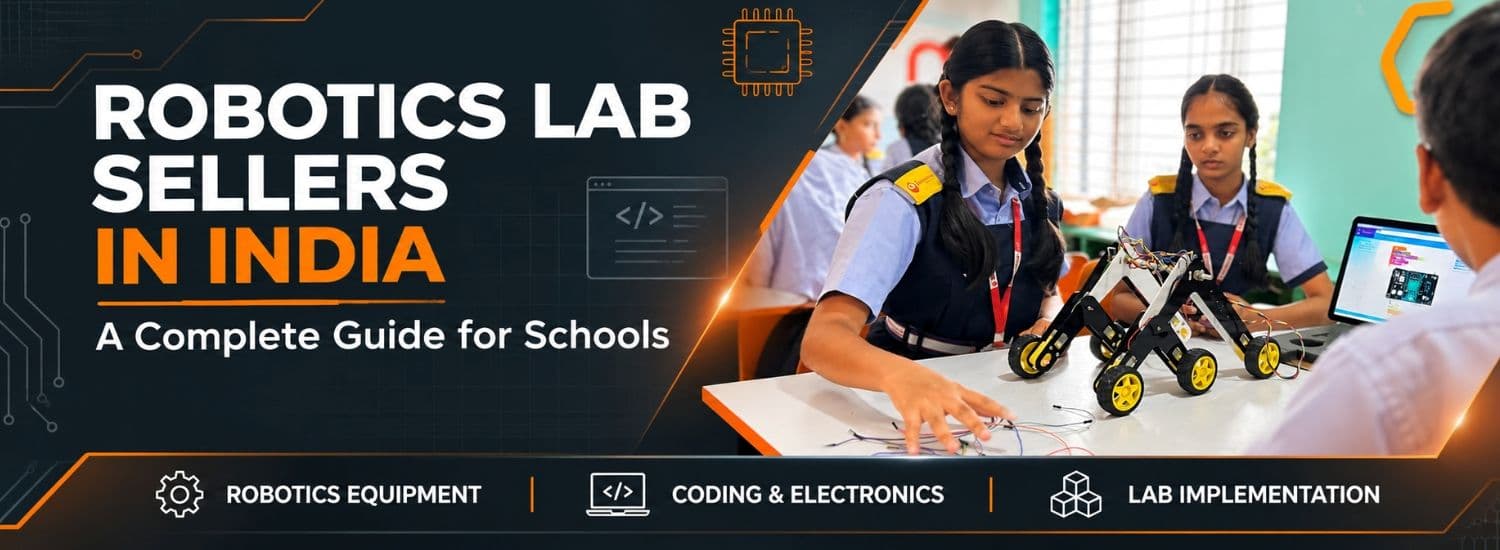


Robotics Lab Sellers in India: A Complete Guide for Schools
Introduction: Why Robotics Labs Are Becoming Important in Schools
Education is changing as schools look for ways to connect classroom concepts with real-world applications. They also need opportunities to build, experiment, solve problems, and learn from their mistakes. Today, Robotics Lab Sellers in India help schools explore practical learning environments where students can understand robotics, engineering, coding, electronics, and design thinking. A well-planned robotics lab gives students the opportunity to turn ideas into working models while developing creativity, logical reasoning, teamwork, and problem-solving skills.
For school management, selecting the right partner involves more than purchasing equipment. Schools need a suitable curriculum, age-appropriate learning resources, teacher training, technical support, and a clear implementation plan. Choosing a partner that understands these requirements can make robotics education easier to introduce and manage.
CognoSpace supports experiential learning through Composite Skill and STEM Labs, combining infrastructure, hands-on activities, digital learning resources, teacher support, and laboratory maintenance. Its approach helps schools connect practical activities with structured learning rather than treating robotics as an isolated subject.
What Should Schools Expect from Robotics Lab Sellers in India?
When evaluating Robotics Lab Sellers in India, schools should consider the complete learning experience rather than focusing only on the number of kits available.
A school robotics lab should provide resources that help students understand how machines operate, how sensors collect information, and how programming instructions control the movement or behaviour of a robot.
Reliable Robotics Lab Suppliers in India for schools should help institutions understand which equipment suits different age groups, how activities fit into the curriculum, and how teachers can conduct practical sessions effectively.
Schools should look for the following elements:
- Robotics and engineering kits suitable for different grades
- Sensors, motors, electronic components, and programmable devices
- Hands-on activity manuals and structured lesson plans
- Coding and computational thinking activities
- Suitable workstations and equipment storage
- Teacher orientation and technical assistance
- Regular maintenance and replacement support
- Assessment methods to understand student progress
The right combination depends on the school's available space, student strength, budget, curriculum, and long-term educational objectives.
Understanding Robotics Lab Providers in India
The term Robotics Lab Providers in India covers organisations that may offer equipment, laboratory design, curriculum resources, installation, training, or complete implementation support.
However, not every supplier offers all these services. Some focus mainly on robotics kits, while others help schools establish and operate a complete learning environment.
When comparing Robotics Lab Vendors in India, school administrators should ask whether the proposed solution includes classroom-ready activities, educator training, implementation guidance, and after-installation support.
Robotics Lab Manufacturers in India may develop or produce specific hardware, components, and robotic systems. Robotics Lab Equipment Suppliers may focus on supplying those products to schools and other educational institutions.
Understanding these differences helps schools select a partner according to their actual requirements.
Instead of choosing a provider solely because it offers more equipment, schools should evaluate whether students and teachers will be able to use the resources effectively.
How to Choose Robotics Lab Sellers in India for Schools
Finding suitable Robotics Lab Sellers in India requires a clear understanding of the school's objectives. A robotics lab for primary students may focus on simple mechanisms, movement, construction, and basic programming. Middle and secondary school students may be ready for more advanced engineering concepts, automation, sensors, and computational thinking.
Before finalising a partner, schools should consider five important factors:
1. Curriculum and Activity Planning
A robotics lab should have a structured learning pathway. Activities should progress from basic concepts to more complex applications, allowing students to develop confidence gradually.
Schools should ask how the curriculum supports classroom learning and whether activities are mapped to the relevant grades and learning objectives.
2. Quality and Variety of Equipment
Robotics Lab Equipment Suppliers should explain the purpose of each major component and how students will use it during practical sessions.
The equipment should be appropriate for the students' age groups, classroom conditions, and intended activities. Schools should also understand the requirements for consumables, storage, repairs, and replacements.
3. Teacher Training
Teachers play a central role in successful robotics education. Even a well-equipped lab may remain underused if educators are not confident about conducting activities.
Look for partners that provide orientation, lesson guidance, activity instructions, and ongoing assistance.
4. Installation and Technical Support
Robotics Lab Installation Services may include setting up workstations, arranging equipment, checking resources, and preparing the lab for classroom use.
Before signing an agreement, schools should clarify what installation covers, how maintenance is handled, and who will provide assistance if equipment stops working.
5. Student Assessment
A good learning programme should help schools understand what students have learned. Practical demonstrations, project presentations, activity-based assessments, and reflection exercises can provide useful insights into student progress.
Robotics Lab Setup for Schools: From Planning to Implementation
A successful Robotics Lab Setup for Schools begins with planning rather than simply ordering equipment.
First, the school should identify its learning objectives, target grades, available classroom space, and expected number of students. The next step is to select appropriate equipment, plan the learning activities, and establish a schedule for practical sessions.
A complete Robotics Lab Setup in India may involve infrastructure, workstations, robotics kits, digital learning resources, activity manuals, educator preparation, and maintenance arrangements.
Schools should also consider how students will share equipment, how components will be stored, and how teachers will track activities across different classes.
For a Robotics Lab for Schools to deliver meaningful outcomes, practical work must be connected to clear learning goals. Students should understand not only how to assemble a model but also why it works, what problems it solves, and how it could be improved.
This structured approach makes the lab a regular part of learning instead of a space that students visit only occasionally.
Robotics Lab Equipment for Schools and Its Role in Learning
Choosing suitable Robotics Lab Equipment for Schools is an important part of designing a useful learning environment.
Common resources may include building components, motors, sensors, microcontrollers, electronic modules, structural models, coding tools, and robotics kits. The exact selection should depend on the curriculum and student level.
School Robotics Lab Equipment should encourage students to explore concepts through practical tasks. For example, a simple movement-based project can introduce mechanical principles, while a sensor-based activity can help students understand how a system responds to its surroundings.
Robotics Education Kits allow learners to assemble models, test different configurations, identify errors, and improve their designs. These activities can help students develop patience, logical thinking, creativity, and collaboration.
An Educational Robotics Lab can also connect robotics with mathematics and science. Students may measure distances, compare movement, observe cause and effect, or investigate how changes to a design affect performance.
The goal is not simply to produce a working robot. It is to help students understand the concepts behind the model.
How CognoSpace Supports Robotics and Experiential Learning
CognoSpace offers a structured approach to experiential learning through Composite Skill and STEM Labs. Founded by BITS-Pilani alumni, the organisation combines learning infrastructure, a skill-based curriculum, hands-on resources, digital content, and school support.
Its programme covers grades III–IX and includes activities across conceptual learning, robotics and engineering, technology and artificial intelligence, and arts and life skills.
The robotics and engineering module includes areas such as mechatronics, electrical science, structural engineering, design thinking, mechanics, hydraulics, renewable energy, tinkering, drones, and the Internet of Things.
Step 1: Lab Infrastructure and Resources
CognoSpace provides a Composite Skill/STEM Lab environment with workstations, storage, STEM models, digital resources, and practical learning equipment. The supplied material describes infrastructure equipped with more than 500 tools for hands-on learning.
Robotics and engineering kits form part of the broader learning resources, allowing schools to introduce practical activities in a structured environment.
Step 2: Curriculum and Activity-Based Learning
The programme includes 650+ hands-on activities across its learning modules. Activities are designed to help students move from understanding a concept to applying it through practical work.
This approach helps connect robotics and engineering with science, mathematics, computational thinking, and real-world applications.
Step 3: Teacher Training and Classroom Execution
Schools can train their own faculty or opt for a well-trained CognoSpace educator, depending on the selected offering.
The programme also includes digital content through a Learning Management System, activity instructions, and a weekly delivery plan. These resources help teachers organise sessions and guide students through practical tasks.
Step 4: Evaluation and Progress Tracking
The session structure described by CognoSpace includes visual learning, experiential learning, and evaluation with reflection. A typical session is organised into 10 minutes of visual learning, 25 minutes of practical learning, and 10 minutes of evaluation and reflection.
Assessments, learning profiles, and progress dashboards help schools review learning outcomes and monitor student development.
Step 5: Maintenance and Ongoing Support
CognoSpace includes laboratory maintenance in its described offering, covering repair or replacement of lab infrastructure, gadgets, and kits, along with restocking consumables as required.
Dedicated relationship management, faculty support, and in-person visits are also part of its delivery approach. These services can help schools manage the lab beyond the initial installation.
For schools exploring Robotics Lab Solutions for Schools, this integrated model provides a way to consider infrastructure, curriculum, educator preparation, and ongoing support together.
Why Schools Should Invest in a Robotics Learning Lab
A Robotics Learning Lab gives students an opportunity to explore technology through direct experience. Instead of only reading about mechanisms or programming, learners can build models, test their ideas, and observe results.
The potential benefits include:
- Practical understanding: Students connect theoretical concepts with real-world applications.
- Problem-solving: Learners identify errors, test alternatives, and improve their designs.
- Creativity: Students explore different ways to approach a challenge.
- Teamwork: Group projects encourage communication and collaboration.
- Technical confidence: Regular activities introduce students to engineering, electronics, and coding.
- Independent thinking: Students learn to ask questions and investigate possible solutions.
Schools should also plan for consistent use. Regular sessions, trained teachers, appropriate equipment, and age-appropriate projects are essential to making these benefits possible.
Searching for a Robotics Lab Near Me? What Should You Check?
Schools searching online for robotics lab near me may find local suppliers, training centres, educational equipment distributors, and laboratory solution providers.
Before selecting a nearby provider, check whether it works with schools, offers installation at your location, provides teacher training, and supports the equipment after delivery.
A local presence can be useful for communication and service visits, but location alone does not guarantee the quality of a learning programme.
Ask for details about the curriculum, equipment list, implementation timeline, training arrangements, maintenance terms, and references from schools where similar projects have been completed.
Schools should compare proposals on the basis of learning outcomes and the total support offered rather than price alone.
Conclusion
Choosing the right Robotics Lab Sellers in India is an important step for schools that want to introduce practical technology education. The right solution should bring together appropriate equipment, a structured curriculum, teacher preparation, student assessment, and ongoing technical support.
Robotics Lab Providers in India differ in their offerings, so school leaders should evaluate the complete implementation plan before making a decision.
CognoSpace brings together Composite Skill and STEM Lab infrastructure, hands-on activities, digital learning resources, educator support, assessments, and maintenance. This integrated approach can help schools organise experiential learning across robotics, engineering, science, mathematics, and technology.
Ultimately, the value of a robotics lab depends on how effectively students use it. With suitable resources, prepared educators, and consistent practical sessions, schools can create opportunities for learners to build, experiment, collaborate, and develop skills for the future.
Frequently Asked Questions
1. What do Robotics Lab Sellers in India provide?
Depending on the provider, offerings may include robotics kits, lab equipment, workstations, curriculum resources, installation, teacher training, and maintenance support.
2. How can schools choose Robotics Lab Suppliers in India for schools?
Schools should compare equipment quality, curriculum, grade suitability, teacher training, installation support, maintenance, and total cost.
3. What is included in a Robotics Lab Setup for Schools?
A setup may include workstations, robotics kits, sensors, motors, coding resources, activity manuals, storage, teacher training, and technical support.
4. What equipment is required for a school robotics lab?
Common resources include building components, motors, sensors, controllers, electronic modules, robotics kits, and programming tools. The final list depends on student age and learning objectives.
5. Does CognoSpace provide robotics learning resources?
Yes. Its Composite Skill and STEM Lab programme includes robotics and engineering kits, practical activities, digital learning content, and teacher support.
6. How can schools choose the best Robotics Lab Sellers in India?
Schools should evaluate the quality of robotics equipment, curriculum, hands-on activities, teacher training, installation services, and ongoing technical support before selecting Robotics Lab Sellers in India.
7. What services do Robotics Lab Sellers in India provide to schools?
Robotics Lab Sellers in India may provide robotics kits, lab infrastructure, coding resources, activity manuals, teacher training, installation, and maintenance support, depending on their offerings.
8. What is the cost of setting up a robotics lab in India?
The cost depends on the lab size, equipment, number of students, technology requirements, curriculum, and training services. Schools should request a customised quotation based on their specific needs.
9. Why should schools work with experienced Robotics Lab Sellers in India?
Experienced providers can help schools plan the lab, select suitable equipment, organise practical learning activities, train teachers, and maintain resources for consistent classroom use.
10. How does CognoSpace help schools establish a robotics lab?
CognoSpace supports schools through Composite Skill and STEM Lab infrastructure, robotics and engineering kits, structured hands-on activities, digital learning resources, teacher training, student assessments, and lab maintenance.