
Robotics Lab Sellers in India:
A Complete Guide to Robotics Lab Setup, Infrastructure
and Implementation for Schools
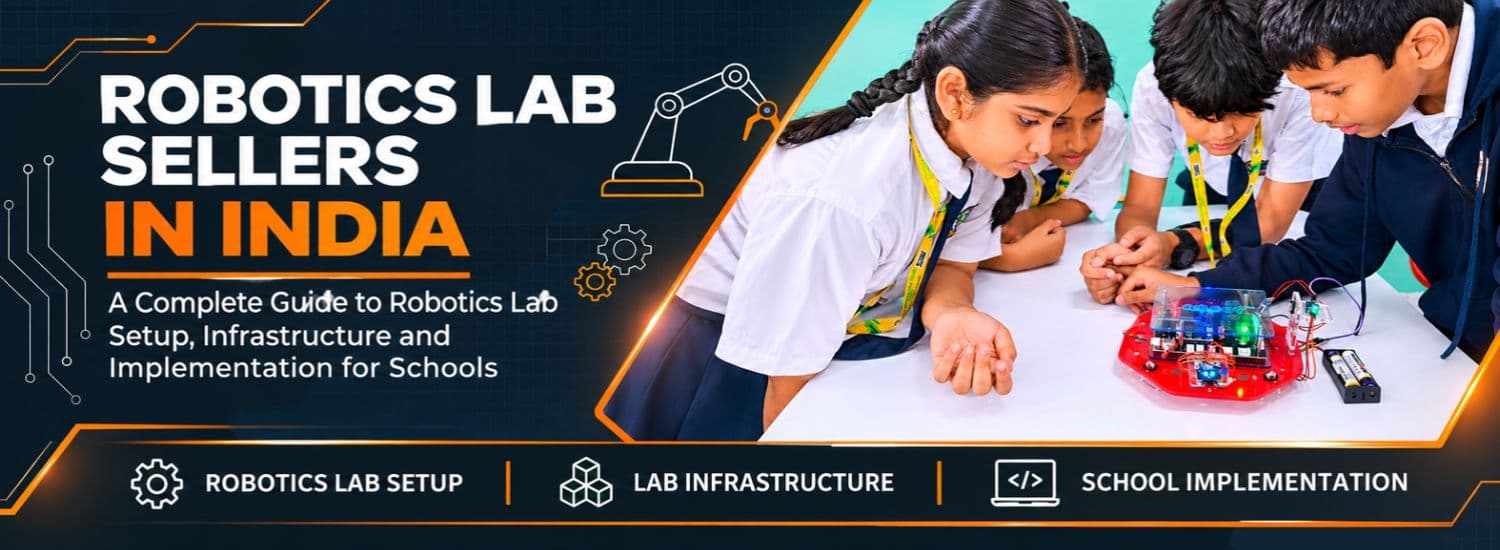


Robotics Lab Sellers in India: A Complete Guide to Robotics Lab Setup, Infrastructure and Implementation for Schools
Robotics Lab Sellers in India: A Complete Guide to Robotics Lab Setup,
Introduction
Technology is transforming education, and robotics is becoming an important part of preparing students for the future. Schools across India are increasingly introducing practical learning environments where students can understand engineering, programming, electronics, automation and problem-solving through hands-on activities.
As a result, the demand for Robotics Lab Sellers in India is growing among CBSE schools, international schools and educational institutions looking to strengthen their STEM education programmes.
A robotics laboratory is not simply a room filled with robots and electronic components. It is a dedicated learning environment where students explore scientific concepts, assemble robotic models, write programmes, experiment with sensors and develop solutions to real-world problems.
Choosing the right Robotics Lab Sellers in India requires schools to evaluate more than equipment prices. They need a partner that understands educational requirements and can provide infrastructure, curriculum, installation, teacher training and continuous academic support.
Whether a school is planning a new laboratory or upgrading its existing facilities, selecting the right implementation partner can make a significant difference to student learning outcomes.
In this guide, we discuss the essential components of a school robotics laboratory, how to evaluate vendors, what infrastructure is required and how CognoSpace supports experiential learning in schools.
1. Why Are Robotics Labs Important for Schools?
Robotics introduces students to the practical application of Science, Technology, Engineering and Mathematics.
Instead of learning concepts only through textbooks, students get opportunities to build models, connect electronic components, programme robots and observe how different systems work.
This approach encourages curiosity and helps students develop skills that are increasingly important in modern education.
A well-designed school robotics laboratory can help students develop:
- Logical and computational thinking.
- Programming and coding skills.
- Engineering and design abilities.
- Critical thinking and problem-solving.
- Creativity and innovation.
- Teamwork and collaboration.
- Communication and presentation skills.
- Practical application of scientific concepts.
Schools searching for Robotics Lab Sellers in India should therefore prioritise educational outcomes rather than focusing only on the number of kits included in a package.
A good robotics programme should provide progressive learning opportunities from basic mechanical activities to advanced robotics and automation projects.
2. What Should Schools Expect from Robotics Lab Providers in India?
Professional Robotics Lab Providers in India should offer a complete learning ecosystem that supports both students and teachers.
A laboratory should be designed according to student strength, available space, grade levels and academic objectives.
The major components include:
A. Robotics Learning Kits
Robotics kits allow students to assemble and programme different robotic models.
Common components include:
- Robotics building blocks.
- Motors and motor drivers.
- Sensors and actuators.
- Microcontrollers.
- Electronic components.
- Wheels, gears and mechanical structures.
- Programmable controllers.
These kits help students understand mechanical systems, electronics and programming through practical experimentation.
B. Coding and Programming Platforms
Programming is an essential component of robotics education.
Students should be introduced to age-appropriate programming environments that help them understand commands, sequences, conditions, loops and logical operations.
C. Electronics and Automation
Students can experiment with circuits, sensors, microcontrollers and automation systems.
Activities such as automatic lighting, obstacle detection and smart monitoring help connect theoretical concepts with practical applications.
D. Curriculum and Learning Materials
A laboratory should include structured activity manuals, project guides, teaching resources and assessments.
Schools should ensure that learning activities are appropriate for different grades and progressively develop students' technical abilities.
When evaluating Robotics Lab Suppliers in India, it is important to check whether these academic resources are included with the equipment.
3. How to Choose Robotics Lab Setup Companies in India
There are several Robotics Lab Setup Companies in India offering different laboratory configurations. However, not every company provides the same level of academic and technical support.
School management should evaluate the following factors before selecting a vendor.
1. Curriculum Quality
The curriculum should be designed according to the learning requirements of different grade levels.
It should cover:
- Introduction to Robotics.
- Mechanical structures.
- Electronics and circuits.
- Coding and programming.
- Sensors and automation.
- Engineering design.
- Project-based learning.
- Practical assessments.
2. Equipment Quality
Schools should evaluate the durability, safety, usability and educational relevance of the supplied equipment.
Robotics Lab Manufacturers in India should be assessed based on their product quality, manufacturing capabilities and ability to provide replacement components.
3. Teacher Training
Teachers need practical knowledge to conduct robotics activities effectively.
The selected vendor should provide training sessions, demonstrations, teaching manuals and ongoing academic assistance.
4. Installation and Maintenance
A professional implementation partner should support laboratory planning, installation, equipment testing and maintenance.
5. Long-Term Academic Support
Schools should check whether the company provides curriculum updates, project guidance, consumable refills and technical assistance throughout the academic year.
These factors help schools identify reliable Robotics Lab Companies in India rather than selecting a supplier based only on initial pricing.
4. Robotics Lab Setup for Schools: Essential Infrastructure
A successful Robotics Lab Setup for Schools requires an appropriate combination of physical infrastructure, equipment and learning resources.
The laboratory should provide enough space for students to work individually and in groups.
The essential infrastructure includes:
| Component | Purpose |
|---|---|
| Robotics kits | Building and assembling robots |
| Computers | Programming and simulation |
| Microcontrollers | Hardware programming |
| Sensors | Detecting environmental changes |
| Motors and actuators | Movement and automation |
| Electronic components | Circuit building |
| Mechanical components | Engineering experiments |
| Workstations | Collaborative activities |
| Display systems | Demonstrations and presentations |
| Storage facilities | Safe equipment management |
Robotics Lab Infrastructure for Schools should also include suitable electrical connections, ventilation, internet connectivity, safety arrangements and organised storage.
Schools planning a new laboratory should consider the number of students using the facility at the same time.
5. What Makes Professional Robotics Lab Suppliers Different?
Choosing Robotics Lab Suppliers in India should involve evaluating the complete educational solution.
A supplier that provides only equipment may not be sufficient for a school that needs curriculum development, teacher training and implementation assistance.
Similarly, Robotics Lab Equipment Suppliers should demonstrate that their products support multiple experiments and practical applications.
Schools should ask the following questions:
- Are the kits suitable for different age groups?
- Can students perform multiple experiments?
- Are the components reusable?
- Are project manuals included?
- Is teacher training available?
- Are replacement components available?
- Does the supplier offer ongoing support?
The focus should be on creating a laboratory that remains useful throughout the academic year.
6. School Robotics Lab Setup: Moving Beyond Equipment
A successful School Robotics Lab Setup should create a learning environment where students can experiment, collaborate and develop projects.
Simply installing robotics equipment does not guarantee meaningful learning.
Students need structured activities that introduce concepts gradually and encourage independent experimentation.
For example, younger students can begin with basic mechanical structures and simple motor activities. As they progress, they can explore sensors, programming, automation and advanced robotic applications.
This progression allows students to develop confidence while strengthening their technical understanding.
Schools evaluating Robotics Lab Development for Schools should therefore consider curriculum planning alongside infrastructure development.
The laboratory should also provide opportunities for students to demonstrate their projects through exhibitions, competitions and presentations.
7. Robotics and STEM Lab Setup: Integrating Multiple Technologies
Robotics becomes more effective when integrated with other STEM disciplines.
A Robotics and STEM Lab Setup introduces students to the relationship between science, mathematics, engineering and technology.
For example:
- Science explains the principles behind motion and energy.
- Mathematics helps students understand measurements and calculations.
- Engineering introduces design and construction.
- Technology provides tools for programming and automation.
Students can combine these concepts to build working models and solve practical challenges.
Robotics Lab Solutions for Schools should encourage interdisciplinary learning instead of treating robotics as an isolated subject.
An integrated learning environment also creates opportunities to introduce Artificial Intelligence, IoT, electronics and computational thinking.
This helps students understand how modern technologies work together.
8. How to Find the Best Robotics Lab Companies in India
When comparing the Best Robotics Lab Companies in India, schools should look beyond marketing claims.
A reliable company should demonstrate its academic expertise, implementation capabilities and experience working with educational institutions.
Consider these evaluation parameters:
Experience: Does the company understand school-level education and student learning requirements?
Curriculum: Does it provide a structured, grade-wise learning programme?
Manufacturing: Does it have the ability to develop or customise educational equipment?
Training: Does it provide practical teacher training?
Implementation: Can it manage laboratory planning and installation?
Support: Does it provide ongoing academic and technical assistance?
Innovation: Does it regularly introduce new projects and activities?
Schools should also request product demonstrations and understand how the proposed laboratory will be used during regular academic sessions.
9. Robotics Lab Near Me: How Schools Can Identify Local Providers
School management teams often search online for Robotics Lab Near Me when planning a new laboratory.
These searches can help identify nearby companies, equipment suppliers and educational service providers.
However, geographical proximity should not be the only selection criterion.
A nearby company may provide equipment but may not offer a complete curriculum or academic support programme.
Schools searching for Robotics Lab Providers Near Me should compare the company's infrastructure, experience and service capabilities.
Similarly, searching for Robotics Lab Suppliers Near Me may help identify local equipment sources, but schools should evaluate the educational value of the products.
Before finalising a partner, schools should also consider:
- Experience in school laboratory implementation.
- Availability of demonstrations.
- Installation capabilities.
- Teacher training.
- Maintenance support.
- Curriculum development.
The same approach applies when searching for Robotics Lab Setup Near Me or Robotics Lab Companies Near Me.
A reliable partner should understand the school's requirements and provide a solution that supports long-term academic objectives.
10. Robotics Lab Installation Companies and Implementation Process
Selecting professional Robotics Lab Installation Companies is important for ensuring that the laboratory is properly planned and commissioned.
A structured implementation process generally includes:
Step 1: Requirement Assessment Understanding the school's student strength, available space, grade levels and learning objectives.
Step 2: Laboratory Design Planning the layout, workstations, storage areas, electrical points and equipment configuration.
Step 3: Equipment Supply Providing robotics kits, electronics, computers, sensors and other required resources.
Step 4: Installation and Testing Assembling workstations, organising equipment and checking whether all components function correctly.
Step 5: Teacher Training Conducting practical training sessions to help teachers understand the equipment and curriculum.
Step 6: Academic Implementation Introducing students to structured activities, experiments and project-based learning.
Step 7: Maintenance and Support Providing technical assistance, replacement components and regular academic guidance.
Schools should also compare Robotics Lab Installation Companies based on their ability to provide support after the initial setup.
11. Robotics Education Lab Providers: Building Practical Learning Experiences
Robotics Education Lab Providers play an important role in connecting technology with school education.
Their responsibility should extend beyond supplying robotic models.
They should develop learning experiences that help students understand the principles behind each activity.
For example, when students build an obstacle-avoiding robot, they learn about sensors, programming logic, motor control and decision-making.
Similarly, a line-following robot introduces students to electronics, sensor feedback and control systems.
Educational Robotics Lab Providers should design such activities according to student learning levels.
A structured programme also helps teachers assess student progress through practical demonstrations and project evaluations.
12. Robotics Lab Franchise Providers and Business Models
Some organisations operate through franchise or partnership models to expand their robotics education services.
Robotics Lab Franchise Providers may offer branded educational programmes, curriculum resources, equipment packages and implementation support.
Schools should understand whether the proposed model is suitable for their institutional requirements.
They should evaluate curriculum ownership, training responsibilities, equipment quality, support arrangements and long-term costs before entering into any partnership.
For institutions seeking a direct educational partnership, a complete implementation model may be more appropriate than a franchise arrangement.
13. Robotics Lab Design and Installation: What Should Schools Consider?
Robotics Lab Design and Installation should focus on student convenience, safety and effective utilisation of available space.
A well-designed laboratory should include:
- Dedicated student workstations.
- Group collaboration areas.
- Equipment storage.
- Demonstration spaces.
- Project display areas.
- Safe electrical arrangements.
- Adequate lighting and ventilation.
The laboratory should also be flexible enough to support different activities and student groups.
Robotics Lab Design and Installation should be planned with the curriculum in mind so that the infrastructure supports the activities students will actually perform.
14. Turnkey Robotics Lab Solutions for Schools
Turnkey Robotics Lab Solutions simplify the process of establishing a complete school laboratory.
Instead of coordinating with multiple suppliers, schools can work with one implementation partner for infrastructure, equipment, curriculum and training.
A complete solution may include:
1. Requirement assessment.
2. Infrastructure planning.
3. Laboratory design.
4. Equipment supply.
5. Installation.
6. Curriculum development.
7. Teacher training.
8. Student activities.
9. Academic monitoring.
10.Maintenance and support.
Schools evaluating Robotics Lab Solutions for Schools should check whether the vendor offers these services as part of the overall programme.
A turnkey approach can reduce coordination challenges and help schools establish laboratories that are ready for regular academic use.
15. Why CognoSpace Is a Robotics and Experiential Learning Partner for Schools
When comparing Robotics Lab Vendors for Schools, school management should consider the company's educational philosophy, research capabilities, infrastructure and support system.
CognoSpace works with schools to develop integrated experiential learning environments that bring together Robotics, Artificial Intelligence, IoT, STEM, Automation and 21st-century skills.
Founded by BITS Pilani alumni, CognoSpace focuses on creating practical learning opportunities through research-driven curriculum, educational equipment and integrated laboratory infrastructure.
Integrated Composite Skill Labs
CognoSpace develops Composite Skill Labs that introduce students to multiple technology domains within one learning environment.
These laboratories bring together Robotics, AI, IoT, STEM and practical skill development.
800+ Learning Activities
CognoSpace has developed an extensive learning ecosystem featuring 800+ activities that encourage experimentation, creativity and application-based learning.
In-House Manufacturing
Its manufacturing and product development capabilities include:
- Laser cutting.
- 3D printing.
- Injection moulding.
- Fabrication and prototyping.
- Educational kit development.
These capabilities support the development of customised educational resources.
Teacher Training and Academic Support
CognoSpace supports schools through intensive teacher training, academic consultations, implementation guidance and ongoing assistance.
Development of 21st-Century Skills
The learning approach focuses on developing critical thinking, teamwork, leadership, communication, creativity and problem-solving abilities.
For schools evaluating Robotics Lab Sellers in India, CognoSpace offers an integrated approach that connects infrastructure with curriculum and practical student experiences.
Conclusion
Robotics education is becoming an important part of preparing students for a technology-driven future.
A well-designed laboratory gives students opportunities to understand engineering, programming, electronics and automation through practical experiences.
However, the success of a robotics laboratory depends on selecting the right implementation partner.
Schools should evaluate curriculum, equipment, infrastructure, teacher training, installation and long-term academic support before making a decision.
When comparing Robotics Lab Sellers in India, school management should focus on the complete educational ecosystem rather than equipment prices alone.
With its experience in experiential learning, Robotics, AI, IoT, STEM and Composite Skill Labs, CognoSpace aims to help schools create engaging and future-ready learning environments.
Planning to establish a Robotics Lab in your school?
Connect with CognoSpace to explore customised robotics laboratory infrastructure, equipment, curriculum and implementation solutions.
Website: https://cognospace.in/
Frequently Asked Questions (FAQs)
1. How can schools choose reliable Robotics Lab Sellers in India?
Schools should evaluate curriculum quality, robotics equipment, infrastructure, installation experience, teacher training, maintenance and academic support before selecting a robotics laboratory partner.
2. What services do Robotics Lab Sellers in India provide?
Robotics laboratory vendors generally provide robotics kits, programming tools, electronic components, laboratory infrastructure, curriculum, installation, teacher training and technical assistance.
3. What is the cost of setting up a robotics laboratory through Robotics Lab Sellers in India?
The cost depends on laboratory size, student strength, equipment configuration, curriculum, infrastructure and support requirements. Schools should request a customised proposal based on their needs.
4. Which Robotics Lab Sellers in India provide complete school solutions?
Schools should shortlist companies offering integrated infrastructure, equipment, curriculum, teacher training, installation and ongoing academic support rather than equipment supply alone.
5. Do Robotics Lab Sellers in India provide teacher training?
Professional vendors may provide practical teacher training, curriculum orientation, activity demonstrations and continuous academic assistance. Schools should verify the training programme before selecting a partner.
6. Why should schools compare Robotics Lab Sellers in India before purchasing equipment?
Comparing vendors helps schools evaluate equipment quality, educational relevance, curriculum coverage, implementation capabilities and long-term support.
7. Can Robotics Lab Sellers in India customise laboratories for CBSE schools?
Yes. Robotics laboratories can be customised according to school requirements, available space, student strength, grade levels and applicable academic guidelines.
8. What equipment should schools expect from Robotics Lab Sellers in India?
Common equipment includes robotics kits, microcontrollers, motors, sensors, actuators, electronic components, programming tools, computers and project development resources.
9. Are Robotics Lab Sellers in India offering turnkey laboratory solutions?
Several providers offer integrated solutions covering infrastructure planning, equipment supply, installation, curriculum, teacher training and maintenance. Schools should confirm the exact scope of each proposal.
10. How does CognoSpace help schools looking for Robotics Lab Sellers in India?
CognoSpace provides integrated experiential learning solutions covering Robotics, Artificial Intelligence, IoT, STEM and Composite Skill Labs, supported by curriculum, practical equipment, teacher training and academic assistance.