
STEM Lab Setup for Schools:
A Complete NEP 2020 Implementation Guide
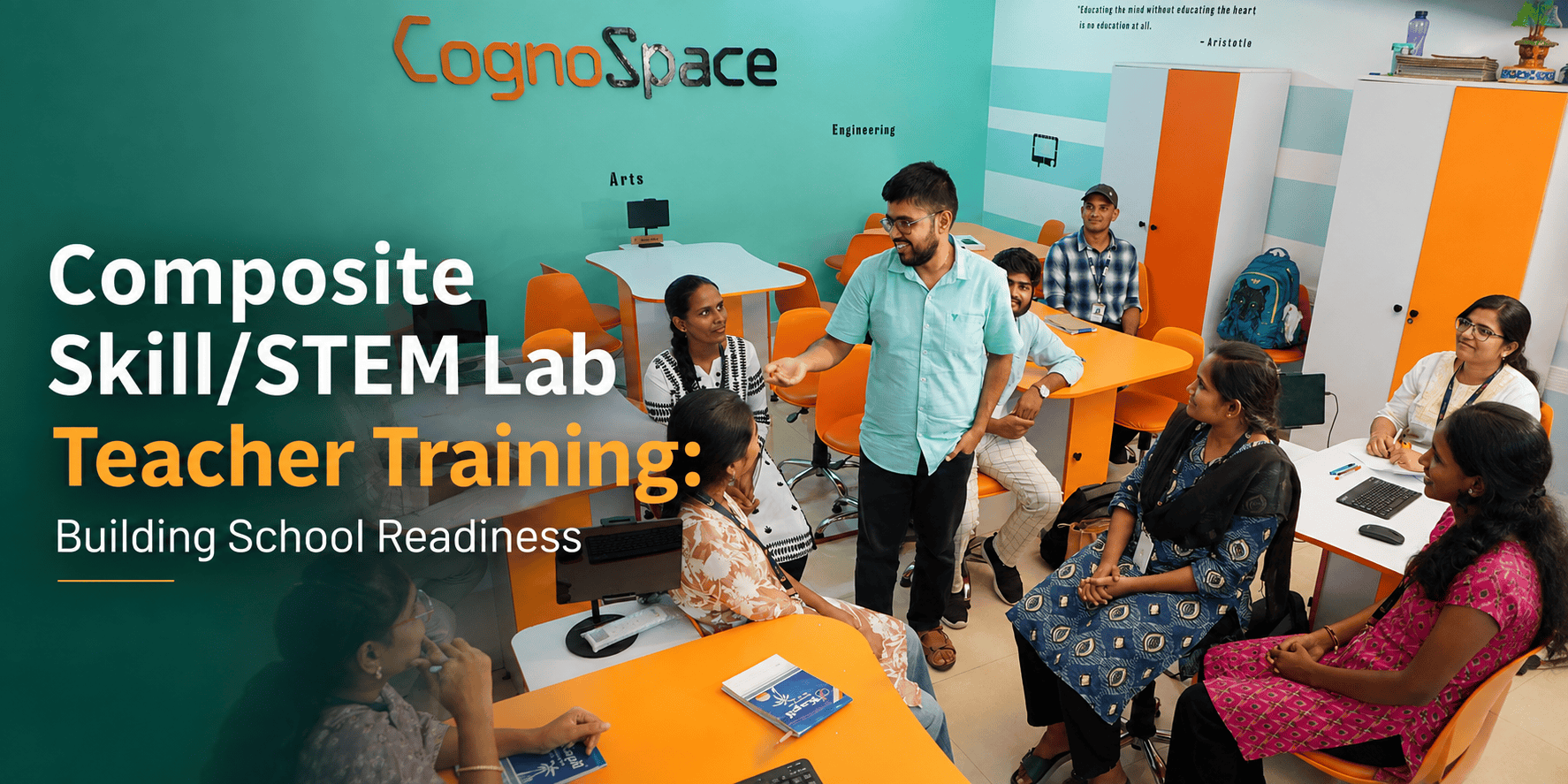


Imagine walking into a school laboratory where students are not simply watching a demonstration. One group is building a mechanical model, another is working on an electronics activity, while others are exploring mathematics, robotics, engineering, or technology.
This is the kind of learning environment schools are increasingly looking to create.
But setting up such a space involves much more than purchasing a few kits and putting them into a classroom. Schools need to think about curriculum, infrastructure, furniture, equipment, teacher support, installation, maintenance, and how students will actually use the lab throughout the academic year.
That is where STEM lab requirements for schools become important.
CognoSpace approaches this differently. Rather than treating the laboratory as only a physical room, its Composite Skill & STEM Lab model combines the physical infrastructure with a skill-based curriculum, hands-on resources, digital learning support, trained educators, assessments, and ongoing maintenance. The CognoSpace website describes the model as experiential learning through Composite Skill Labs, designed to connect classroom knowledge with real-world application.
What Are the STEM Lab Requirements for Schools?
The first step in any school STEM lab setup is understanding what the school actually needs.
A useful lab should support the age group, curriculum, available space, class size, and learning objectives. It should also give students enough opportunities to work with materials rather than simply observe equipment.
Typical STEM lab requirements for schools include:
- A suitable learning space
- Student workstations
- Storage units
- Presentation facilities
- Science and mathematics resources
- STEM models
- Robotics and engineering kits
- Technology-enabled learning resources
- Activity manuals and instructional content
- Safety and electrical provisions
- Teacher training
- Regular maintenance
- A structured activity plan
CognoSpace's current infrastructure includes workstations, tablets, STEM models, storage units, a presentation platform, a 3D printer, TV/display facilities, and STEM kits. Its website also describes more than 500 STEM kits as part of the Composite Skill Lab infrastructure.
The brochure provided for CognoSpace further lists workstations, a presentation platform, robotics and engineering kits, 3D printing, science-math concept kits, books/lab manuals, an LMS, STEM models, and tablets for each workstation.
Understanding STEM Lab Infrastructure
Good STEM lab infrastructure should make practical learning easy rather than create another classroom that students only visit occasionally.
The physical environment needs to support collaboration, demonstrations, experimentation, and project work.
For example, students may need to sit together while building an engineering model, move around during a robotics activity, or use a workstation while following digital instructions.
CognoSpace describes its lab as an engaging and collaborative environment designed around 21st-century skills, with the lab fully built and maintained by the company.
The brochure also highlights the infrastructure required for experiential learning, including workstations, storage, electrical points, presentation facilities, STEM models, tablets, and a 3D printer.
This means STEM lab infrastructure should be planned around how students will learn, not simply around how the room will look.
STEM Lab Design for Schools: What Should It Include?
STEM lab design for schools should balance flexibility, accessibility, storage, technology, and student movement.
A practical design can include:
Student Workstations
Students need dedicated spaces where they can conduct activities, assemble models, use kits, and collaborate with classmates.
Presentation Area
A presentation platform or display area allows teachers to introduce an activity and students to explain their work.
Storage
STEM activities involve many small components. Proper storage helps teachers organize kits, consumables, models, and equipment.
Technology Zone
Tablets, displays, 3D printers, and other digital resources can support technology-focused activities.
Demonstration and Display Space
STEM models can turn the laboratory and wider school campus into spaces that showcase student learning and innovation.
CognoSpace's infrastructure page identifies tablets, workstations, 3D printers, TV displays, presentation platforms, STEM models, storage units, books/manuals, and STEM kits among its lab components.
Therefore, STEM lab design for schools should begin with the activities students will perform and then determine the space, furniture, storage, and equipment needed.
STEM Lab Furniture: More Than Tables and Chairs
STEM lab furniture should support practical work.
Traditional classroom desks may not always be suitable for activities involving models, electronics, robotics, or collaborative projects.
Good STEM lab furniture should help students:
- Work in groups
- Access activity materials
- Assemble models
- Conduct experiments
- Use digital devices
- Store resources efficiently
- Move between activities safely
CognoSpace's lab model includes student workstations and storage units as part of its infrastructure.
The brochure similarly identifies workstations, storage units, cabinets, and electrical points within the Composite Skill/STEM Lab infrastructure.
When planning STEM lab furniture, schools should therefore consider the complete learning workflow instead of purchasing furniture separately from the rest of the lab.
STEM Lab Equipment for Schools: What Do Students Actually Need?
One of the most common questions schools ask is: what should be included in a STEM lab?
A useful STEM lab equipment list depends on the curriculum and student age, but a multidisciplinary setup can include:
- Science experiment resources
- Mathematics concept kits
- STEM models
- Robotics kits
- Engineering kits
- Electronics resources
- Coding and computational-thinking resources
- 3D printing facilities
- Tablets or digital devices
- Presentation/display equipment
- Activity books and lab manuals
- Storage systems
- Consumables
CognoSpace's curriculum covers Science and Mathematics, Robotics & Engineering, Technology, Arts & Life Skills, and Design Thinking, with more than 600 activities and 30+ modules listed on its current website.
The brochure expands this into areas such as electrical science, renewable energy, sci-tech toys, tinkering, structural engineering, mechatronics, kinematics, mechanics, IoT, hydraulics, drones, artificial intelligence, 3D printing, app development, coding, computational thinking, and other skill-focused areas.
This is why STEM lab equipment for schools should not be selected simply by counting the number of devices. The important question is whether students can use those resources to perform meaningful activities.
STEM Lab Equipment List: A Practical Way to Plan
A STEM lab equipment list can be divided into categories instead of creating one long list.
Science and Mathematics
These resources help students move from theoretical concepts to practical activities.
Robotics and Engineering
Robotics and engineering kits can introduce students to mechanics, electronics, design, construction, and problem-solving.
Technology
Technology resources can support coding, computational thinking, AI-related learning, app development, and digital fluency.
Models and Demonstration Resources
STEM models can make complex ideas visible and provide opportunities for discussion and exploration.
Digital Resources
Tablets, digital content, explainer videos, and an LMS can support students and teachers during and after lab sessions.
The CognoSpace model combines physical resources with digital support. Its website lists an LMS mobile app, explainer videos, books/lab manuals, educator support, and weekly delivery plans as part of its delivery model.
STEM Lab Installation: What Happens After the Purchase?
Buying equipment is only one part of creating a functioning laboratory.
STEM lab installation needs to consider the physical arrangement of the room, workstations, storage, technology, equipment, displays, and activity resources.
For schools, this can be challenging because different vendors may supply different parts of the laboratory.
CognoSpace's approach is to provide the lab as an integrated solution. The company states that its Composite Skill Lab is fully built and maintained by CognoSpace.
The brochure also describes complete maintenance, including repair and replacement of lab infrastructure, gadgets, and kits, along with stocking and restocking consumables as required.
This makes STEM lab installation less about assembling individual products and more about creating a ready-to-use learning environment.
STEM Lab Setup Cost: What Determines the Investment?
Schools often search for STEM lab setup cost before beginning the planning process.
However, there is no single universal cost for every school.
The STEM lab setup cost can change depending on:
- Number of students
- Number of workstations
- Grades covered
- Size of the laboratory
- Number and type of STEM kits
- Robotics and engineering resources
- Technology requirements
- Furniture
- Storage
- Digital learning resources
- Installation requirements
- Teacher training
- Maintenance and support
Therefore, schools should evaluate the complete solution rather than comparing only the initial equipment price.
When evaluating a STEM lab setup cost, it is useful to ask whether the proposal includes installation, curriculum, training, consumables, maintenance, digital content, and ongoing support.
STEM Lab Cost in India: Why Package Comparison Matters
The question of STEM lab cost in India becomes more meaningful when schools compare what is actually included in each offering.
A low initial price may not represent the lowest overall investment if the school later needs to purchase teacher training, replacement equipment, curriculum content, maintenance, or additional resources separately.
Similarly, a comprehensive package may include infrastructure, equipment, curriculum, educator support, digital content, and maintenance.
CognoSpace's brochure presents its offering as a combination of lab infrastructure, curriculum, digital content, faculty training, educator support, and complete maintenance rather than only a room full of equipment.
For this reason, schools evaluating STEM lab costs in India should compare the complete scope of implementation.
How CognoSpace Handles STEM Lab Setup
This is where CognoSpace's model differs from a basic equipment-supply approach.
The company positions its offering as a 360° experiential learning program through Composite Skill & STEM Labs. Its website describes three connected areas: skill-based curriculum, Composite Skill Lab infrastructure, and delivery and support.
1. Curriculum
CognoSpace provides an activity-based curriculum with 600+ activities and 30+ modules across Science, Mathematics, Robotics & Engineering, Arts & Life Skills, Technology, and Design Thinking.
2. Infrastructure
The lab includes workstations, tablets, STEM models, storage, presentation facilities, 3D printing, and STEM kits.
3. Educator Support
Schools can use trained educator support, while CognoSpace also provides faculty training as part of its delivery model. The brochure states that schools can train their own faculty or deploy a CognoSpace-trained educator.
4. Digital Learning
The lab is supported by an LMS, mobile-accessible instructions, explainer videos, books, and lab manuals.
The brochure describes a session flow that combines visual learning, experiential activity, reflection, evaluation, and post-session/home learning.
5. Maintenance
CognoSpace includes complete maintenance of the lab, with repair and replacement of infrastructure, gadgets, and kits and restocking of consumables.
6. Ongoing School Support
The delivery model includes Relationship Manager support, weekly delivery plans, virtual support, PTM support, competition support, assessments, and certification.
This integrated approach means the school STEM lab setup continues beyond the day the laboratory is installed.
From STEM Lab Installation to Regular Classroom Learning
A laboratory creates value only when students actually use it.
CognoSpace structures its sessions around a 45-minute learning flow:
- Visual learning
- Experiential activity
- Reflection
- Evaluation
- Post-session and at-home learning
The brochure describes activity resources, instructions, mobile-app access, assessment, public speaking, and take-home activities as parts of the session experience.
This helps schools connect the physical laboratory to everyday teaching rather than treating it as an occasional exhibition space.
STEM Lab Requirements for Schools: The Role of Teachers
Even the best STEM lab requirements for schools cannot replace the role of teachers.
Teachers need to understand:
- How to introduce an activity
- How to guide student exploration
- How to ask meaningful questions
- How to manage group activities
- How to connect activities to curriculum concepts
- How to assess student learning
- How to encourage students to explain their solutions
CognoSpace provides faculty training and the option of a trained educator, helping schools bridge the gap between infrastructure and classroom implementation.
What Makes a Good School STEM Lab Setup?
A successful school STEM lab setup should bring several elements together:
Infrastructure + Equipment + Curriculum + Teachers + Digital Content + Maintenance + Assessment
If one of these elements is missing, the school may have a laboratory but not necessarily a strong experiential-learning program.
For example, having robotics kits without a structured activity plan may result in limited usage. Similarly, having excellent infrastructure without teacher training can make implementation difficult.
CognoSpace brings these components together through its Composite Skill Lab model, which combines infrastructure, curriculum, educator support, digital content, assessments, competitions, and maintenance.
A Better Way to Evaluate STEM Lab Equipment for Schools
When comparing STEM lab equipment for schools, school leaders should ask:
- Is the equipment suitable for the target grades?
- Does it connect with the school's curriculum?
- Can students use it independently or in groups?
- Are activity instructions provided?
- Is teacher training included?
- Are consumables available?
- Is maintenance provided?
- Is digital learning support available?
- Can the equipment support multiple activities?
- Is there ongoing implementation support?
These questions are more useful than simply asking how many kits or devices are included.
Final Thoughts
Creating a STEM laboratory is not simply a matter of purchasing equipment and placing it inside a classroom.
A meaningful STEM lab setup requires thoughtful planning across infrastructure, curriculum, equipment, furniture, technology, teacher training, installation, maintenance, and student engagement.
The CognoSpace approach combines these elements into a Composite Skill & STEM Lab model. Its offering brings together a skill-based curriculum, lab infrastructure, STEM and robotics resources, digital learning content, trained educators, assessments, ongoing support, and maintenance.
For schools considering a new laboratory, the most important question is therefore not only “How much does a STEM lab cost?”
It is:
“What will our students be able to learn, build, explore, and create once the lab is running?”
That shift, from buying equipment to designing an entire learning experience—is what can turn a STEM laboratory into a meaningful part of school education.
About CognoSpace
CognoSpace is a BITS-Pilani alumni initiative focused on experiential learning through Composite Skill Labs. Its current offering combines skill-based curriculum, STEM and robotics resources, lab infrastructure, digital content, educator support, assessments, and maintenance for schools.
Frequently Asked Questions (FAQs)
1. What are the key STEM lab requirements for schools?
A STEM lab typically needs suitable space, student workstations, storage, STEM models, science and mathematics resources, robotics and engineering kits, digital learning resources, safety provisions, teacher training, maintenance, and a structured activity plan.
2. What should be included in a STEM lab setup for schools?
A complete setup can include workstations, storage, presentation facilities, STEM kits, robotics and engineering resources, tablets, 3D printing, activity manuals, digital learning support, and consumables.
3. How should schools plan STEM lab infrastructure?
Schools should plan infrastructure around student activities and learning outcomes. The layout should support collaboration, experimentation, demonstrations, project work, technology use, and safe movement.
4. What equipment is needed in a school STEM lab?
Depending on the grades and curriculum, equipment may include science and mathematics kits, STEM models, robotics and engineering kits, electronics resources, coding resources, 3D printing facilities, tablets, display equipment, manuals, storage systems, and consumables.
5. How much does a STEM lab setup cost in India?
There is no single standard cost. STEM lab cost in India depends on factors such as the number of students, workstations, grades covered, laboratory size, equipment, furniture, technology, installation, teacher training, and maintenance requirements.
6. What factors should schools consider when comparing STEM lab costs?
Schools should compare the complete scope of the solution, including infrastructure, equipment, curriculum, teacher training, digital content, installation, consumables, maintenance, and ongoing support rather than only the initial equipment price.
7. Why is teacher training important for a STEM lab?
Teachers need to know how to introduce activities, guide exploration, manage group work, connect activities with curriculum concepts, assess learning, and encourage students to explain their solutions.
8. What does a complete STEM lab installation involve?
STEM lab installation involves more than placing equipment in a room. It includes arranging workstations, storage, technology, equipment, displays, and activity resources to create a ready-to-use learning environment.
9. How does CognoSpace support schools after STEM lab installation?
CognoSpace's model includes educator support, faculty training, digital learning resources, assessments, Relationship Manager support, weekly delivery plans, competition support, certification, and ongoing maintenance.
10. What makes a successful school STEM lab setup?
A successful STEM lab brings together infrastructure, equipment, curriculum, teachers, digital content, maintenance, and assessment so that students regularly use the laboratory for meaningful hands-on learning.