
Top 10 Things School Leaders
Should Know About Skill Labs
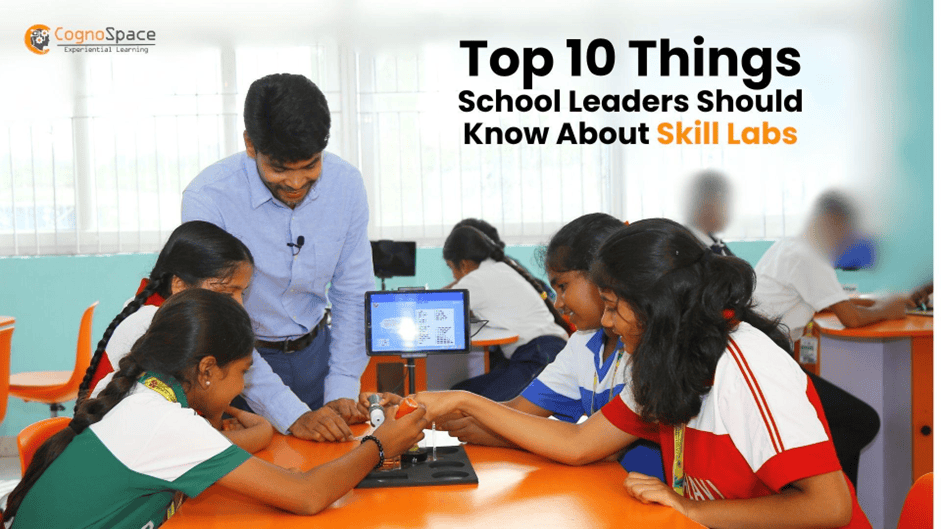


In today’s rapidly evolving education landscape, schools across India are moving beyond traditional classroom teaching and embracing experiential learning. From Hyderabad to Bangalore and other metro cities, school leaders are increasingly investing in STEM, STEAM, robotics, and engineering labs to prepare students for future careers and real-world problem-solving.
Skill labs are no longer an “extra facility” — they are becoming an essential part of modern education. Here are the top 10 things school leaders should know before setting up a skill lab in their institution.
1. Skill Labs Transform Learning from Theory to Practice
Traditional learning often focuses heavily on textbooks and memorization. Skill labs introduce hands-on learning experiences where students actively build, experiment, design, and solve problems.
Whether it is a STEM lab setup for schools or a robotics lab for schools in India, practical learning helps students understand concepts faster and retain knowledge better.
Students learn by:
- Building models
- Conducting experiments
- Solving engineering challenges
- Working on real-world projects
- Collaborating in teams
This shift toward experiential learning in schools improves both academic performance and student engagement.
2. STEM and STEAM Education Are Becoming Essential in India
Schools across metro cities are rapidly adopting STEM and STEAM education models to align with future industry needs.
A well-designed STEAM lab setup in India combines:
- Science
- Technology
- Engineering
- Arts
- Mathematics
This interdisciplinary approach encourages creativity alongside technical knowledge.
Today, parents and educators increasingly prefer schools that provide advanced STEM education solutions in India because they prepare students for careers in AI, robotics, coding, engineering, and innovation.
3. Robotics Labs Build Future-Ready Skills
A robotics lab for schools in India is one of the most effective ways to develop 21st-century skills.
Students gain exposure to:
- Robotics
- Coding
- Automation
- Sensors and electronics
- AI fundamentals
- Problem-solving
Robotics activities also improve logical thinking, creativity, and teamwork.
Schools in Hyderabad, Bangalore, and other urban education hubs are already integrating robotics programs into their curriculum to stay competitive.
4. Skill Labs Support NEP 2020 Goals
India’s National Education Policy (NEP 2020) strongly emphasizes:
- Experiential learning
- Skill-based education
- Innovation
- Critical thinking
- Multidisciplinary learning
School innovation labs directly support these objectives by creating interactive learning environments where students apply concepts practically instead of learning passively.
For school leaders, investing in skill labs also demonstrates alignment with modern educational reforms.
5. Engineering Labs Encourage Innovation Early
An engineering lab for schools introduces students to design thinking and real-world problem-solving from an early age.
Popular engineering lab activities for schools include:
- Bridge building
- Mechanical design projects
- Electronics experiments
- Renewable energy models
- Smart city concepts
These activities encourage innovation, creativity, and analytical thinking while making science and mathematics more engaging.
6. Skill Labs Improve Student Engagement
Many students lose interest in traditional classroom instruction because learning feels repetitive or disconnected from real life.
Hands-on learning labs increase participation because students:
- Learn interactively
- Work in teams
- Build real projects
- Explore technology creatively
Schools that implement STEM and robotics labs often notice:
- Better classroom participation
- Increased curiosity
- Higher attendance
- Greater student confidence
This creates a more dynamic learning environment for both teachers and students.
7. Teacher Training Is Just as Important as Infrastructure
A successful STEM lab setup for schools requires more than just equipment.
School leaders should ensure:
- Proper teacher training
- Curriculum integration
- Structured activity plans
- Continuous support
The best robotics curriculum providers in India also provide teacher enablement programs so educators can confidently conduct lab sessions and guide students effectively.
Without proper training, even advanced labs may remain underutilized.
8. Skill Labs Strengthen School Branding
Parents today actively look for schools that provide modern learning opportunities.
A well-established STEM lab in Hyderabad or robotics lab in Bangalore can significantly improve a school’s reputation and admissions appeal.
Skill labs showcase a school’s commitment to:
- Innovation
- Future-ready education
- Technology integration
- Holistic learning
This becomes a major differentiator in competitive education markets across India.
9. Skill Labs Can Be Customized for Different Grades
One common misconception is that robotics and engineering labs are only suitable for senior students.
In reality, skill labs can be designed for:
- Primary schools
- Middle schools
- Secondary schools
Activities can be age-appropriate and gradually increase in complexity.
For younger students:
- Simple STEM kits
- Basic engineering models
- Creative building exercises
For older students:
- Robotics
- Coding
- Electronics
- AI and automation projects
This ensures long-term educational value across all grade levels.
10. The Right Education Partner Makes a Huge Difference
Choosing the right STEM education provider in India is critical for long-term success.
School leaders should look for partners that offer:
- Curriculum-aligned solutions
- Teacher training
- Technical support
- Activity-based learning modules
- Custom lab setup options
- Long-term implementation support
An experienced education provider can help schools create impactful learning environments that truly benefit students.
Why Skill Labs Are the Future of School Education
As education continues evolving, schools must move beyond traditional teaching methods and adopt innovation-driven learning environments.
From STEM lab setups for schools to robotics and engineering labs, skill labs empower students with practical knowledge, creativity, and future-ready skills.
Schools across Hyderabad, Bangalore, and other metro cities in India are already embracing experiential learning to prepare students for tomorrow’s world.
For school leaders, investing in skill labs is no longer just an upgrade — it is a strategic step toward building a future-ready institution.